How cities can build belonging into future urban developments
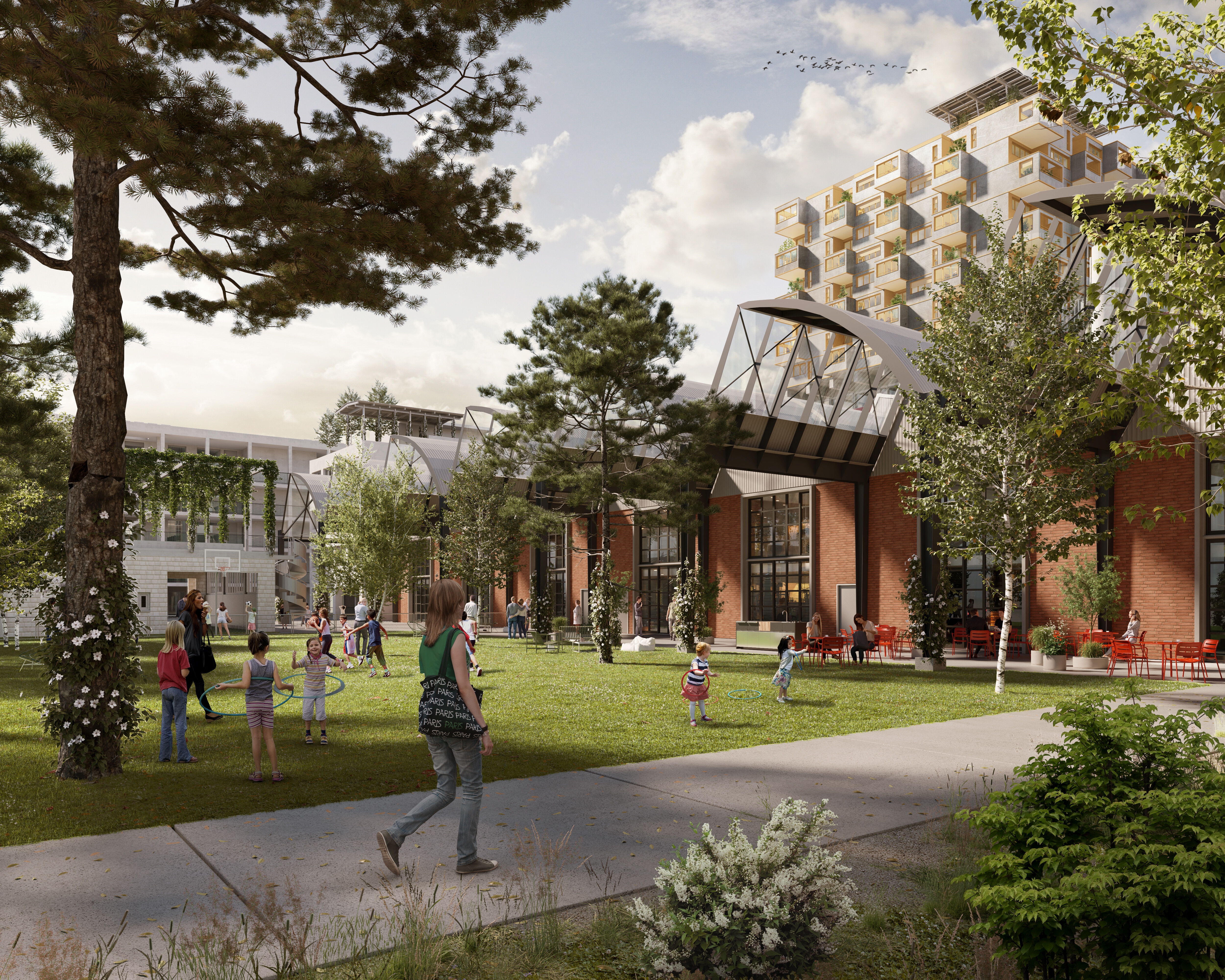
Bern's Wankdorfcity 3 channels 'baukultur' by conserving heritage buildings and weaving them into a new, higher-density neighbourhood Image: Wankdorfcity 3
Oliver Martin
Vice Director, Head of Cultural Heritage and Baukultur Directorate, Swiss Federal Office of Culture (FOC)- Switzerland's baukultur approach involves building high-quality living environments that create long-term value for people, cities, places and investors.
- Bern's Wankdorfcity 3, for example, has used collaboration, mixed-use design and long-term investment to turn an underused site into a new neighbourhood.
- Building more homes while strengthening resilience and social cohesion means encouraging belonging in new neighbourhoods, not just constructing better buildings.
Cities around the world face a common challenge: a need to build more homes, create economic opportunity and accelerate the climate transition – while also creating places where people genuinely want to live.
The answer cannot lie in buildings alone.
A developer can construct homes, offices and public spaces, but it cannot manufacture a sense of belonging. That develops over time, through the relationships people form with each other and with the places they inhabit. What urban development can do is create the conditions in which those relationships are more likely to emerge.
In Switzerland, one answer has emerged through high-quality baukultur, or “building culture” – a holistic approach to the living environment that recognizes that the quality of our towns, cities and landscapes shapes economic prosperity, environmental sustainability and social wellbeing.
But ideas alone do not transform neighbourhoods. They must be translated into investment decisions, planning processes and places that people experience every day. An example of this is already taking shape in Bern.
Wankdorfcity 3 is transforming a former commercial and industrial site on the edge of the Swiss capital into a mixed-use urban district that will eventually be home to around 1,000 residents and 1,000 students, as well as providing 1,500 jobs and a wide range of commercial, cultural and leisure facilities.
Backed by a CHF 500 million investment from Swiss real estate fund IMMOFONDS, the project is exploring how high-quality baukultur can create long-term value for communities, businesses and investors alike.
Developing what already exists
Many regeneration projects begin with demolition. Wankdorfcity 3 began by considering what is worth preserving.
Instead of clearing the site and starting again, the project is conserving heritage buildings and weaving them into a new, higher-density neighbourhood. Existing businesses are being retained wherever possible, with roughly 3,000 square metres of over 100,000 sqm leased to existing tenants. This recognizes that successful places evolve from the people, enterprises and histories already rooted there.
At the centre of the district, an existing industrial shed (see main image, above) will become its social heart, housing restaurants, cultural venues, sport and educational facilities and small businesses. Rather than treating heritage as a constraint, the development uses it to create identity and continuity – qualities that can help transform a collection of buildings into a genuine neighbourhood.
This continuity matters for belonging. New development can provide spaces for community, but people need reasons to form an attachment to them. Preserving traces of a place's history, supporting existing communities and creating spaces where old and new can meet can provide some of those foundations.
The development plan for Wankdorfcity 3, for example, was produced through collaborative workshops involving the owner, city, neighbourhood community and an advisory committee. Representatives from the surrounding neighbourhood contributed to discussions on density, open space, uses and housing types.
Building cities for growing populations
Cities everywhere are looking for ways to accommodate growing populations. But increasing density does not automatically create vibrant communities.
Wankdorfcity 3 has been designed as a "stacked city", which brings together homes, workplaces, education, retail, culture and public spaces within a compact footprint. By combining a mix of home and work spaces, the development aims to create activity throughout the day while reducing the need for long commutes.
Diversity is also one of the project’s guiding principles. The vision of Wankdorfcity 3 is to create a place where people live, work, study and meet. This helps to build a genuine sense of place rather than simply adding density.
Bringing those activities together also creates more opportunities for the everyday encounters through which community can develop. Urban design cannot determine whether relationships form, but it can make them more likely.
Making collaboration part of urban design
High-quality baukultur places cannot be designed in isolation. The concept of the stacked city requires extensive collaboration between architects, planners, investors, public authorities and local stakeholders. Through workshops and iterative planning, the Wankdorfcity 3 project has evolved over time, drawing on collective intelligence across public and private sectors rather than relying on a single vision.
This collaborative process reflects another hallmark of the Swiss planning tradition: bringing together different disciplines and perspectives to balance environmental performance, economic viability and social value. The result is a neighbourhood shaped not only by architecture, but also by partnership.
Investing for the long-term in quality living
For developers, creating better places is sometimes viewed as adding cost. But the holistic concept of baukultur suggests it creates value.
Investing with a long-term perspective keeps the focus on building properties with strong fundamentals in locations that have been identified as having potential. That philosophy means preserving heritage, creating attractive public spaces, retaining existing businesses and investing in social sustainability are not separate from commercial objectives.
Places that people value become more resilient over time. They attract residents, businesses and investment, adapt more readily to changing economic conditions and continue generating value long after construction is complete.
This is where belonging and investment intersect. In this sense, high-quality living environments are not simply good for communities, they are good long-term investments.
Creating neighbourhoods and building belonging
Every city has its own history, geography and priorities, and no single project can provide a universal blueprint. Nor can a development that is still taking shape claim to have created belonging before people have made the neighbourhood their own. But Wankdorfcity 3 demonstrates that urban challenges – housing, climate resilience, economic competitiveness, social cohesion – can be addressed together rather than separately.
Many of the conditions that influence whether communities ultimately flourish are shaped long before residents move in. Decisions about what to preserve, which uses to combine, how public spaces function, who participates in planning and how investors define long-term value all influence the kind of neighbourhood that can emerge.
Wankdorfcity 3 offers a strong Swiss example of the approach that Switzerland – through its role as founder and chair of the Davos Baukultur Alliance – seeks to represent internationally. The first cohort of the Alliance’s Pioneering Places programme – Kuala Lumpur, Montréal, Nairobi, Utrecht, Medellín and San Francisco – are already applying quality-led approaches to urban challenges.
Switzerland's experience shows that creating better places depends on long-term thinking, collaboration across sectors and investment in quality at every stage of development.
As cities continue to grow, the most important lesson they can learn is that successful urban development is measured by the neighbourhoods we create, not the buildings we construct. Developers cannot build belonging, but they can create the conditions in which people form connections, develop an attachment to place and ultimately choose to call a neighbourhood home.
Don't miss any update on this topic
Create a free account and access your personalized content collection with our latest publications and analyses.
License and Republishing
World Economic Forum articles may be republished in accordance with the Creative Commons Attribution-NonCommercial-NoDerivatives 4.0 International Public License, and in accordance with our Terms of Use.
The views expressed in this article are those of the author alone and not the World Economic Forum.
Stay up to date:
Cities and Urbanization
Related topics:

Forum Stories newsletter
Bringing you weekly curated insights and analysis on the global issues that matter.
More on Built Environment and InfrastructureSee all

Edwin Lai and Shuraim Ahmad Malik
October 12, 2026


