How the American West can restructure its water debt
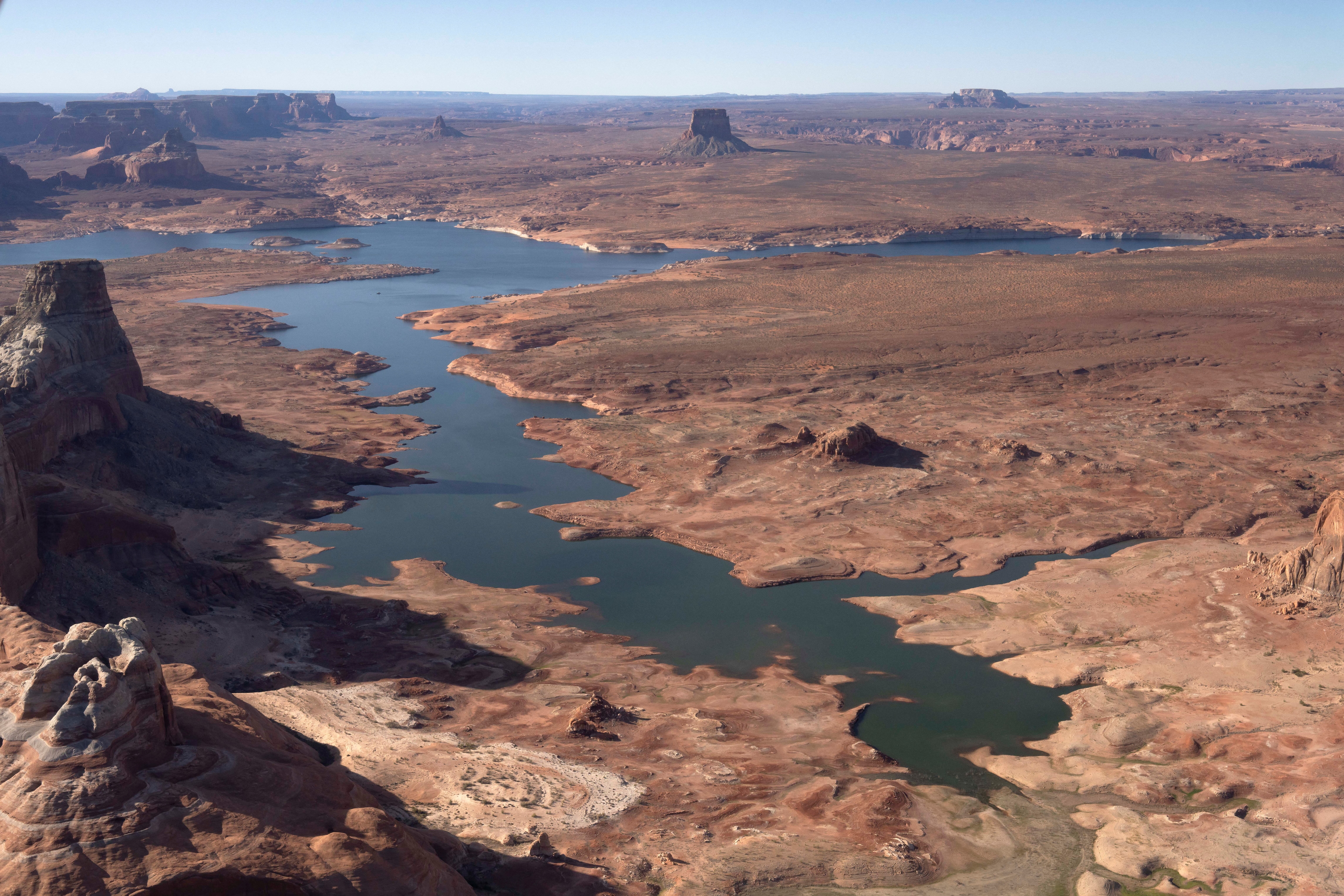
Critically low water levels in Lake Powell, a reservoir of the Colorado River, near Page, Arizona. Image: Reuters/Rebecca Noble
- Facing a 20% drop by 2050, the Colorado River is in a state of water bankruptcy – exacerbating a century-long supply-demand imbalance.
- With the semiconductor and AI industries ramping up water use, the US government has called for water withdrawals to substantially decrease.
- The solutions already exist – from urban and agricultural efficiency to industrial reuse and nature-based restoration – but they need capital and consensus to scale.
This summer, Mina Guli, the CEO of global water awareness non-profit Thirst Foundation, spent her days running the length of the Colorado River, from the snowfields of the Rockies to the scorching depths of the Grand Canyon. You learn things at that pace that no reservoir chart will tell you. You meet the farmer who has fallowed a third of his acreage, and the tribal water manager whose community holds ironclad rights to water it has no pipes to receive.
A river in crisis is usually described as a countdown clock towards running out of water. But from our combined perspective as advocates for water awareness, efficiency and stewardship, it’s a far more dynamic problem. What we’ve found through Keep the River Running, our campaign for the Colorado River, is instead a complex mismatch between supply and demand.
This is not drought. It is bankruptcy
Economists have a term for this, and it is not drought, it is a water bankruptcy. For a century the basin spent more water than nature deposited. The pattern is not unique to the United States. River flows and aquifer depletion across the world shows the same mismatched balance sheets, at various stages of denial.
And on the Colorado, this accounting cannot continue. As our State of the Basin Report: A Guide to the Colorado River Crisis shows, climate models project an additional 20% drop in Colorado River flow by 2050 and 35% by 2100. This is aridification, not a dry spell that ends.
The stakes are high: The river’s water supports 40 million people across seven US states and Mexico, $1.4 trillion in annual economic activity and 16 million jobs, according to a 2014 Arizona State University analysis. It irrigates nearly 90% of the nation's winter vegetable crops, and its two largest reservoirs, Lake Mead and Lake Powell, are at record lows, threatening hydropower generation. Planning for a return to the historical average means building a future economy around a ghost asset.
The US government has quantified the gap: On 21 August, it adopted a new framework that calls for water withdrawals to decrease by up to 3.7 billion cubic metres (3 million acre-feet) a year, depending on conditions over the next decade. This falls on three states: Arizona, California and Nevada.
The growing competition for water: chips, data centres and power
This water bankruptcy’s creditors go beyond the cities, communities and Tribal Nations that depend on it. Semiconductor fabrication and AI infrastructure are both critical industries in the basin, and both have substantial water footprints.
A 2024 report from Lawrence Berkeley National Laboratory estimates that by 2028 hyperscale facilities alone could consume between 60 and 124 billion litres directly. For scale, even at the high end, that’s far less than combined municipal, commercial and industrial use in the basin – but it’s still on par with a city the size of Tucson, or a year's worth of some crops. And the industry is growing.
Major semiconductor manufacturers, significant defence, mining, oil and gas, and energy operations all rely on the Colorado River’s water, too, along with dams and thermoelectric plans that generate power.
For these industries, continuing along a business-as-usual path increases their exposure to “wild risk”, where unpredictable and extreme events can ripple through an entire economy.
Three tools already in the water
Yet the strategies to mitigate that risk are not moonshots. They are Earthshots, and many are already operating in the basin.
1. Urban efficiency. Las Vegas has grown substantially while cutting consumption. The Southern Nevada Water Authority reports a 58% reduction in per capita water use between 2002 and 2023, even as the population grew by more than 786,000, driven by water reuse and by paying people to tear out ornamental turf. Other cities have yet to follow. Nationally, 19.5% of treated drinking water is lost before it reaches a customer or is properly billed – worth $6.4 billion in uncaptured revenue.
2. Corporate infrastructure. Semiconductor manufacturer TSMC is estimated to currently recycle 65% of the water at its north Phoenix complex, and broke ground last year on a 15-acre industrial reclamation plant designed to hit 85% at startup and 90% or better thereafter. Many data centres are also transitioning to more water-efficient cooling, and local governments have begun writing water into land-use law.
3. Nature-based solutions. Restoring wetlands and floodplains builds long-term resilience. Beaver dam analogues, simple structures that slow water and recharge shallow aquifers, are low-tech options that run $50,000 to $100,000 per stream mile against $600,000 to $1 million for conventional engineering. Yet they remain underfunded.
Capital and consensus
All three are time-tested. All three are already at work. None has been scaled. Why not?
A lack of capital is stymying progress, particularly in agriculture and nature-based restoration, which private investors often overlook. Globally, the World Bank finds that about 91% of annual water spending comes from the public sector and less than 2% from private investors.
Such financing is essential for restructuring. In corporate bankruptcies, loans are used to keep operational control, and retain key employees, suppliers and customers. If the Colorado River Basin is to right-size its use of river water without losing jobs, companies and residents, it also needs investments – and urgently.
Restructurings also require consensus. No single company, city or farm can secure a river basin alone. The serious work of reallocating this water needs to happen collectively and collaboratively; not in a courtroom.
Indeed, consensus is already emerging. Through summits held along the river’s course this summer, in Denver, Las Vegas, Phoenix and Los Angeles, our campaign has convened city officials, global companies, tribes and other communities. And when we conclude at Climate Week in New York, Wall Street will be there.
Our water debts will never be as easy to restructure as our corporate or sovereign debt. Shifting how consumers, boardrooms and investors re-value water is a formidable task. It is always hard to price what is everywhere, flowing visibly through our taps, power grids, factories and veins. But it is necessary. And it is inevitable. Water always finds its level.
Don't miss any update on this topic
Create a free account and access your personalized content collection with our latest publications and analyses.
License and Republishing
World Economic Forum articles may be republished in accordance with the Creative Commons Attribution-NonCommercial-NoDerivatives 4.0 International Public License, and in accordance with our Terms of Use.
The views expressed in this article are those of the author alone and not the World Economic Forum.
Stay up to date:
SDG 06: Clean Water and Sanitation
Related topics:


Forum Stories newsletter
Bringing you weekly curated insights and analysis on the global issues that matter.
More on Food, Water and Clean AirSee all

Krishna Kumar
September 21, 2026


