How manufacturers can scale AI and digital transformation across every factory
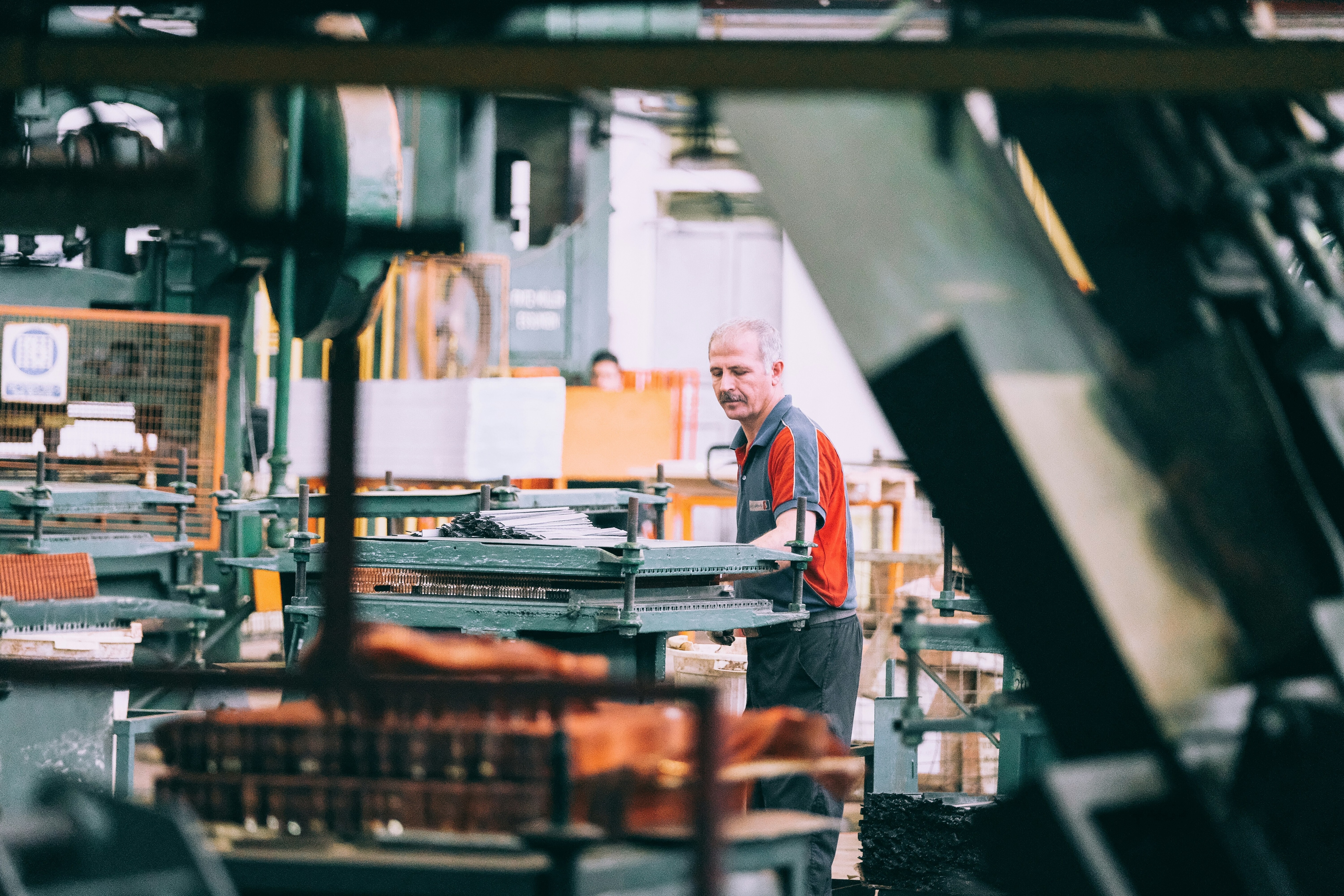
The real test of a smart factory is whether its biggest gains can be replicated elsewhere. Image: Unsplash/Sam Moghadam
Rakesh Kumar Murugan
Global Head and Senior Director – Industrial AI and Sustainability, Bosch Software and Digital Solutions (SDS)- A successful AI pilot is only the beginning: the real advantage comes from replicating what works across a network of factories.
- A 'floor-and-frontier' model combines common foundations of metrics, digital skills and governance across plants, with room for selected sites to test advanced applications.
- The fastest learners design projects for reuse, with clear ownership and funding for replication from the outset.
For eight years, the world’s most advanced factories have shown what is possible when digital technology, artificial intelligence (AI) and operational excellence work together.
A 2026 report from the Global Lighthouse Network – an initiative which highlights the leading manufacturing sites using advanced technology – documented 223 sites across more than 30 countries and 40 industries, showcasing more than 1,150 solutions.
For CEOs and chief operating officers, however, the key question is how excellence produced by one factory can be replicated across a network of plants with different equipment, economics, products and workforce capabilities.
Data from the World Economic Forum exposes the tension. Only 23 Lighthouse organizations had expanded their operational rewiring to three or more sites. At the same time, AI is accelerating the frontier: analytical AI and machine learning are now embedded in nearly 62% of Lighthouses’ top-five use cases, while generative AI reached 23% in 2025, up from 9% in 2024.
Without a mechanism for transferring capability, the distance between the best factory and the rest will widen.
I call the required approach the 'floor-and-frontier' model. Leaders must manage three variables together: frontier height or how far selected sites advance performance; floor breadth or how much of the network has the foundations for repeatable digital value; and adaptation velocity or how quickly validated learning produces value elsewhere.
Why copying a Lighthouse rarely works
Across more than 100 factory visits, I have repeatedly seen the same pattern. Pilots are designed around a strong local sponsor, a particular data set and the best available team. When another plant tries to adopt the solution, definitions change, equipment interfaces differ, operational ownership is unclear and the economics no longer look identical.
What appeared to be a technology replication problem is usually a context and operating-model problem.
Installing the same technology stack everywhere is often uneconomic in brownfield networks. Letting each site build independently multiplies cost and fragmentation. Leaders need to standardize what enables learning to travel while preserving what must remain local.
Build the floor around outcomes
The floor is the minimum set of conditions every site needs: secure access to relevant machine and process data; consistent definitions for critical measures; clear ownership of operational decisions; frontline capability to use digital tools; and governance that connects each use case to business value.
The floor should also define where data and models may operate, when smaller domain-specific models can reduce cost and energy use and where human authority must remain. Scaling AI should not weaken security, sovereignty or accountability.
Taking an illustrative brownfield example from the Forum’s network, ACG Packaging Materials in Shirwal, India, applied ensemble machine-learning models trained on more than two years of golden-batch data to 60-year-old equipment.
The reported results included a 37% improvement in first-pass yield and a 43% reduction in quality set-up time. These gains did not require a greenfield starting point. They required usable foundations and a well-defined operational problem.
Manufacturing advantage will now belong to companies that can spread the excellence in their best factories wider.
”Design the frontier to teach the network
Frontier sites should be selected for their potential returns and the learning they can generate. A useful portfolio may include a high-volume plant, a complex low-volume operation and a legacy site. Every initiative should begin with a second-site question: what would another factory need to reuse this capability?
That encourages modular interfaces, reusable data definitions, cybersecurity controls, training material and explicit operating ownership from the outset. Standardize the grammar, not every sentence.
In current consulting work with diversified manufacturers, we are designing network-wide transformations across multiple business units, products and plants at different levels of digital maturity. One network uses several manufacturing execution systems but lacks a consistent view of business outcomes.
In another, the design is complete and implementation is beginning with a manufacturing execution system and advanced planning and scheduling. The objective is practical: enable leaders to quote for new business using evidence on product cost, delivery time and feasible capacity.
The design must support trade-offs involving delivery time, cost, make-or-buy decisions, resource availability, maintenance and capacity expansion – and allow the network to replan as constraints change. A shared integration backbone and network command centre form the floor, while selected frontier use cases determine what can travel.
Transfer also depends on people and institutions. The Forum describes how Mettler Toledo’s Changzhou site combined internal experts, universities, suppliers and other sites, then extended its transformation to six additional locations. Communities of practice transmit the judgment behind a solution as well as its code.
Make transfer a leadership responsibility
CEOs and COOs should review frontier height, floor breadth and adaptation velocity together. The alternative is to risk rewarding sophisticated but isolated showcases or standardized platforms that create consistency without meaningful improvement.
Every frontier programme needs an owner for reuse, a budget for the reusable core and a receiving site that commits operational capacity. The unit of success is not deployment but realized value in the next context.
The model also changes capital allocation. Instead of asking only for the return at the pilot site, leadership should require two business cases: local value and transfer value. A project with a slightly lower site-level return may deserve priority if it creates reusable capability across a large network.
Conversely, a high-return application may remain local when its operating conditions are unique. This makes transferability a design criterion before funding is released and clarifies which elements belong in an enterprise platform, a shared product or a site-specific configuration.
While every factory does not need the same destination, they do need to benefit from what the network learns. The Global Lighthouse Network has shown how high the frontier can rise. Manufacturing advantage will now belong to companies that can spread the excellence in their best factories wider.
Don't miss any update on this topic
Create a free account and access your personalized content collection with our latest publications and analyses.
License and Republishing
World Economic Forum articles may be republished in accordance with the Creative Commons Attribution-NonCommercial-NoDerivatives 4.0 International Public License, and in accordance with our Terms of Use.
The views expressed in this article are those of the author alone and not the World Economic Forum.
Stay up to date:
Future of Work
Related topics:


Forum Stories newsletter
Bringing you weekly curated insights and analysis on the global issues that matter.
More on Manufacturing and Value ChainsSee all

Jacob Nathan
September 25, 2026