Success in biomanufacturing is now about much more than the molecule
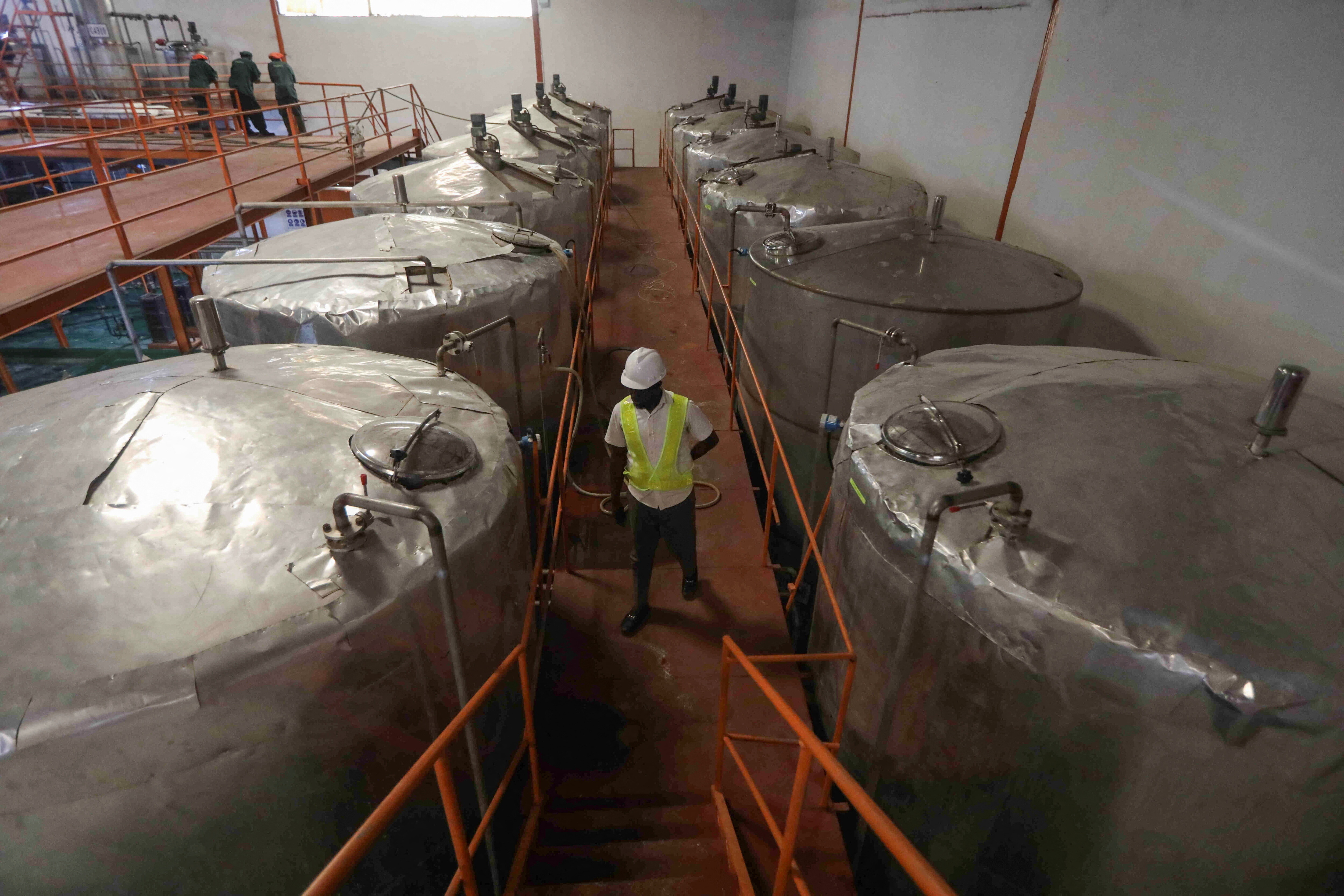
Industrial fermentation capacity is becoming a strategic advantage in the race to scale biomanufacturing. Image: Reuters/Temilade Adelaja
- Breakthrough biology is no longer enough to build a business: one company reached a valuation of more than $3 billion before its manufacturing constraints and commercial setbacks helped bring the company down.
- AI is changing the economics of existing plants, for example one biologics site cut new product introduction time by 42% while raising volume by more than 40%.
- China accounts for more than 70% of global biological fermentation output, according to Chinese official data – and its advantage rests on more than subsidies.
Bio-innovation has spent decades solving problems of discovery, but today, many of the most significant challenges are entrenched in industrialization.
Across food, chemicals, materials, health and fuels, companies are learning the same lesson: scientific breakthroughs alone do not create industrial competitiveness. Success depends on whether biological products can be manufactured economically at commercial scale.
Scale-up remains fundamentally non-linear. Processes that perform well in laboratory bioreactors often become uneconomic or technically unstable at industrial volumes. Yields fall, downstream purification costs rise and biological systems introduce variability that traditional manufacturing does not encounter.
Biology's bottleneck is no longer the lab
The gap between what a biology company can build and what an incumbent already owns illustrates the point. For example, the Every Company engineers yeast to produce egg proteins. Instead of attempting to build its own commercial capacity, Every partnered with BioBrew, the fermentation arm established by AB InBev's venture unit, gaining access to brewing infrastructure operating at 500,000 to one million litres. That is volumes accumulated over a century of making beer, and orders of magnitude beyond what a venture-funded company could finance. The science was Every's. The tanks were not.
The counterfactual is equally instructive. Zymergen went public in April 2021 at a valuation above $3 billion on the strength of its biological engineering platform, while its own prospectus stated plainly: "We do not have our own commercial scale manufacturing capability." Ultimately contract manufacturers could not guarantee supply beyond the end of that year. When customers hit technical difficulties with its flagship product and the market for it proved smaller than forecast, the company had no manufacturing base of its own to fall back on: within four months of listing it announced no expected revenue for 2021, and was sold for $300 million the following year. The biology worked. The manufacturing base did not exist.
The lesson is that biology may generate the innovation, but manufacturing capacity will increasingly determine who captures its value.
How AI is changing biomanufacturing
The discussion around AI and biology today focuses on designing better proteins, engineering better strains, and accelerating discovery. Those advances matter, but they are unlikely to define competitive advantage on their own. Biomanufacturing’s next frontier is using AI to improve manufacturing.
Digital twins, real-time process control, predictive maintenance, continuous fermentation and automated optimization are making biological production increasingly predictable, repeatable and financeable.
Such tools are already operational and delivering reductions in associated production costs, timelines and emissions. For instance, Bristol Myers Squibb's biologics and cell therapy site in Devens, Massachusetts layered more than 30 AI and digital applications onto an existing plant, training models on process data the facility already generated. They cut the time to introduce a new product by 42%, raised manufacturing volume by more than 40% and reduced emissions by more than 40%.
Sanofi has built comparable systems into production and quality decisions across its manufacturing network, and reports that AI-assisted deviation management has cut the time to close minor manufacturing deviations by 60%, while 80% of stock disruptions are now predicted before they occur.
One qualification defines the frontier: almost all the associated advances remain advisory rather than autonomous: models monitor, predict and diagnose, but there are no regulator-approved biomanufacturing processes today that allow a digital twin to intervene directly in production. And none of the advances substitute for steel in the ground. Data-driven optimization makes an existing fermenter more productive, but it does not conjure one into existence.
The companies and countries that generate the most valuable manufacturing data, not simply the most biological data, will ultimately establish the strongest competitive position.
Where industrialization is moving fastest
China benefits from significant investment and strong, forward-looking policymaking in this space. But a lesser understood advantage it holds is coordination.
The forthcoming Policy Maturity Index from the World Economic Forum’s Bioeconomy Initiative puts a number on it: across nearly one thousand bioeconomy policy instruments assessed in seven geographies, financial incentives account for approximately 18.5% of China's assessed instruments – that’s the lowest share in the study, and less than half of India's 38.4%. Every other country anchors its bioeconomy policy in money, whereas China does not. The anchor for China is instead centred around infrastructure and capability development, regulatory instruments and coordination and governance capacity, which accounts for roughly 25% of its portfolio, around two times the average of all other geographies assessed.
In China, national industrial strategy, manufacturing infrastructure, AI capability, financing and commercialization are advancing together. Rather than asking whether biology should become an industrial platform, China is focused on how quickly it can industrialize biology across food, chemicals, materials and health.
One recent instrument shows the approach in operation. In June 2025 two Chinese ministries launched a programme to designate biomanufacturing pilot-scale platforms, the stage between laboratory validation and commercial production where most projects fail. The state does not build the facilities, but certifies pilot plants already operating, requires them to sell open-access services commercially, coordinates their permitting and extends insurance cover to companies using them. The target was more than 20 platforms by 2027; the first batch, published in December 2025, named more than 40.
Other economies are responding from different starting points. The United States remains a leader in frontier science, venture capital and AI. Europe retains exceptional research capability but continues to face challenges translating scientific leadership into industrial deployment. India and Brazil are building competitive positions around feedstock availability, renewable energy and growing domestic demand.
The lesson here is not how much a country spends but which constraint that spending is meant to address. Where scale-up is blocked because permitting, land, environmental approval and offtake sit in four ministries that do not coordinate, no subsidy resolves it. Any government mandating bio-based content without instrumenting fermentation capacity is legislating demand it has no means to supply.
The race for domestic biomanufacturing capability won’t be defined by scientific leadership alone. Increasingly, it is being defined by industrial capability.
Don't miss any update on this topic
Create a free account and access your personalized content collection with our latest publications and analyses.
License and Republishing
World Economic Forum articles may be republished in accordance with the Creative Commons Attribution-NonCommercial-NoDerivatives 4.0 International Public License, and in accordance with our Terms of Use.
The views expressed in this article are those of the author alone and not the World Economic Forum.
Stay up to date:
Biotechnology
Related topics:


Forum Stories newsletter
Bringing you weekly curated insights and analysis on the global issues that matter.
More on Industries in DepthSee all

Stefan Koch, Renée van Heusden and Margi Van Gogh
July 21, 2026


