Nepal's decade of disasters highlights the urgent need for climate finance
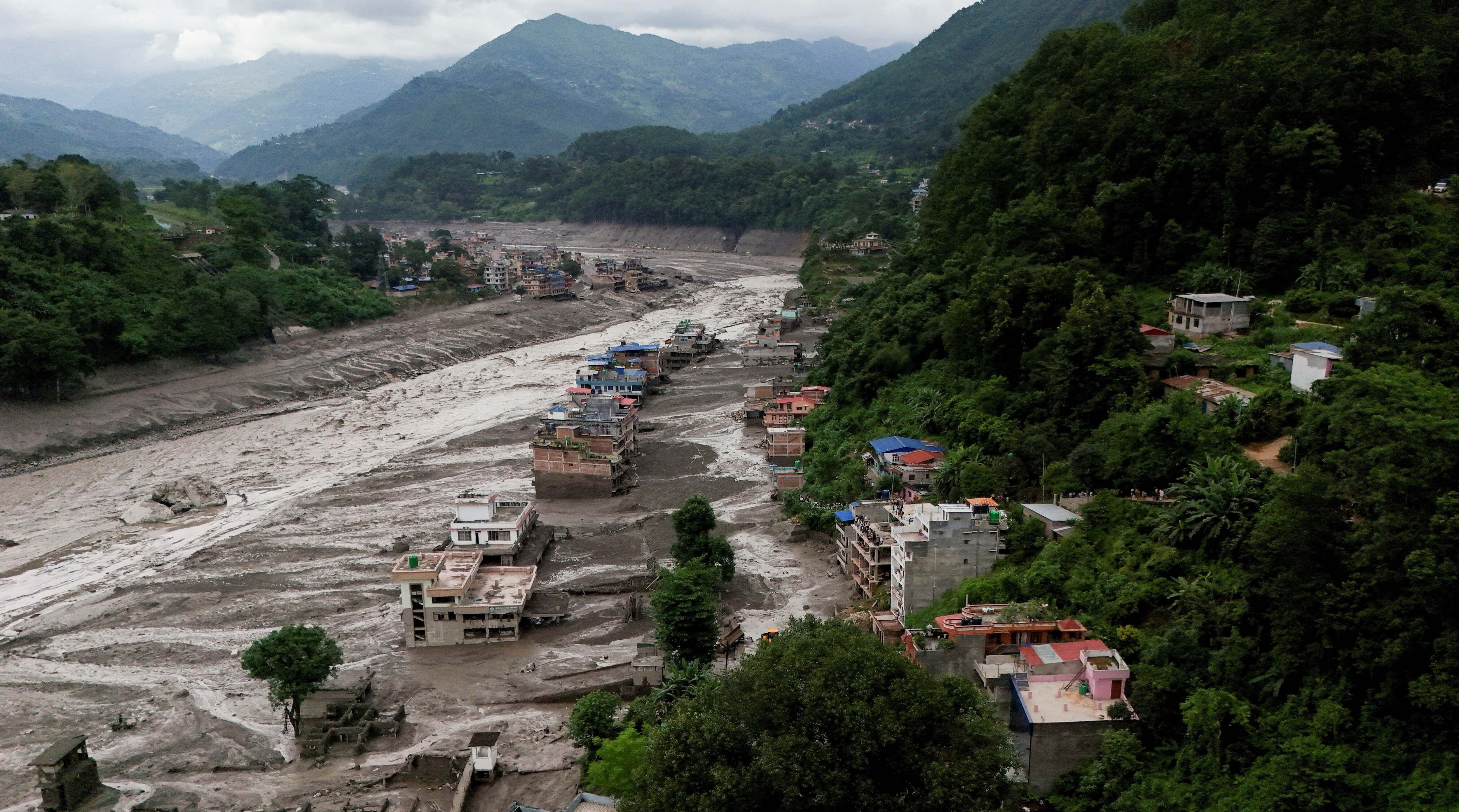
Nepal has faced a number of extreme climate events in recent years, including devastating flooding caused by a glacier collapse. Image: Reuters/Navesh Chitrakar
- Nepal generates just 0.05% of global emissions that fuel extreme climate events, yet has absorbed billions of dollars in disaster losses.
- The country's experience over the last 11 years is a clear example of how some communities are paying for a crisis they did little to cause.
- Climate finance that includes grants over loans and funding for improved early warning systems will help Nepal rebuild with greater resilience.
Nepal produces just 0.05% of the world's carbon emissions and the average Nepali generates 0.63 tonnes of carbon dioxide (CO2) a year – a fraction of the global average. Indeed, the country’s entire cumulative output since 1751 amounts to just 0.01% of everything humanity has ever emitted.
And yet, in the last 11 years, Nepal has absorbed disaster losses equivalent to roughly one-quarter of the country's annual gross domestic product (GDP) due to extreme climate events.
That is the sentence any conversation about climate finance should start with, because Nepal is not an edge case. It is one of the clearest illustrations on the planet of who is paying for a climate crisis they did almost nothing to cause.
How a glacier collapse triggered fatal landslides and floods
On 26 August 2026, a mass of ice and rock that was roughly 0.2 square kilometres in size broke off a slope near Langtang Lirung and fell more than 1 kilometre, melting on impact and sending a wall of water and debris down the Bhote Koshi and Trishuli valleys.
Within 30 minutes, river levels at some points had surged by 9 metres. By the time the water reached the Nepal-China border crossing at Gyirong, it had travelled the distance in minutes.
At least 1,455 people were killed, 5,285 people remained missing and 13,795 had been rescued, according to officials who announced the end of the search and rescue operation on 5 October. Debris and bodies had been found as far as 240km downstream, across the border in India.
It is tempting to read this as one catastrophic event: a glacier collapse, not even a "normal" flood. But treated in isolation, that framing misses the point.
Nepal's flood-warning infrastructure was built to catch monsoon and river floods, not a high-altitude ice collapse. That is not bad luck. It is what happens when a country with limited fiscal room has to choose which hazards its early-warning systems are built for, because it cannot afford to build for all of them.
Nepal has faced a decade without a full recovery
Zoom out, and the Bhote Koshi flood is not a one-off. It is the latest entry in a list of economic hardship Nepal has been experiencing since 2015, starting with the Nepal Earthquake.
In 2017, the Terai floods added another NPR 61 billion (£396.5 million); COVID-19 cost the economy an estimated NPR 198 billion ($1.3 billion) and drove a -2.37% GDP contraction.
Then, in 2023, a second earthquake hit Jajarkot, killing 153 people and destroying more than 62,000 homes across Karnali province. Damage in the worst-hit district alone was put at over $500 million, the 2025 Gen Z protests cost a further NPR 98 billion ($586 million).
Add this year's flood, an initial damage estimate of over NPR 400 billion ($2.6 billion), with officials expecting the fuller Post-Disaster Needs Assessment to come in some 30% higher, putting full reconstruction costs in the $4-5 billion range. That comes on top of an estimated NPR 415 billion ($2.7 billion) that shifting weather patterns alone have cost Nepali farm households over the past five years.
What makes this dangerous is not any single number; it is the periodic cycle that these disasters follow. After the 2015 earthquake, Nepal's economy clawed its way back to a strong recovery, then COVID hit. Recovery resumed, then 2025’s unrest hit.
This time, the Asian Development Bank has cut its post-flood growth forecast to 4.1%, and the government is now debating how much more debt it can safely take on to rebuild. Nepal’s foreign minister has said plainly that the country “prefer[s] grants and aid over loans”, because “loans are ballooning compared to our GDP”. Nepal has simply not been given a long enough gap between shocks to fully rebuild before the next one arrives.
The Bhote Koshi flood destroyed close to 8% of Nepal's national hydropower generation capacity; a sector that supplies more than 90% of the country's electricity and is one of its few major export earners.
This also impacted the Rasuwa trade corridor that carries goods to and from China, and tourism routes toward Mount Kailash that draw travellers from across the world. None of that comes back in a season.
Hydropower plants take years to rebuild; so do mountain roads and bridges. Every month they’re out of service is a month of lost revenue, lost jobs and lost tax base, the compounding cost that never makes the headlines in the way the death toll does.
What this should mean for the rest of the world
Nepal is not a standalone case. The same physics of thinning glaciers, thawing permafrost and destabilized slopes is playing out across every glaciated mountain range on Earth, from the Swiss Alps to Greenland’s ice sheet to India’s own stretch of the Himalaya. What differs between them is who can afford to see it coming.
When a slope above the Swiss village of Blatten began moving in May 2025, three decades of monitoring, tracked by radar, GPS and seismic sensors gave authorities enough warning to evacuate roughly 300 residents days before the mountain came down. One person died.
When a comparable ice-rock avalanche struck Chamoli, in India's own Himalaya, in 2021, no such system existed; 204 people died, and a five-year study concluded plainly that “hazard magnitude alone does not determine disaster outcomes, preparedness does”.
Nepal, this August when the glacier collapsed, had even less monitoring in place than India did. That is the real fault line. Rich, glaciated nations can fund the radar stations, the seismic networks, the decades of continuous observation, but Nepal cannot do that alone.
Nepal’s case is the cleanest argument for climate finance there is: a country that did almost nothing to cause this hazard keeps footing the bill to rebuild from it, alone. It’s a debt someone else's emissions ran up.
Three fixes would change that: grants over debt-deepening loans; monitoring built for the real hazard, not just river gauges; and rebuilding standards that plan for the next disaster.
Nepal will rebuild the Bhote Koshi valley, as it has rebuilt after every disaster before it. The open question is whether it gets to do so on terms that finally break the cycle, or whether this reconstruction, too, simply becomes the thing the next shock interrupts.
Don't miss any update on this topic
Create a free account and access your personalized content collection with our latest publications and analyses.
License and Republishing
World Economic Forum articles may be republished in accordance with the Creative Commons Attribution-NonCommercial-NoDerivatives 4.0 International Public License, and in accordance with our Terms of Use.
The views expressed in this article are those of the author alone and not the World Economic Forum.
Stay up to date:
Climate Crisis

Forum Stories newsletter
Bringing you weekly curated insights and analysis on the global issues that matter.
More on Climate Action and Waste Reduction See all

Hanane Mourchid, Jamil Wyne and Olivia Zeydler
October 6, 2026


