Paying with data, not cash: Towards a new model for affordable healthcare in Africa
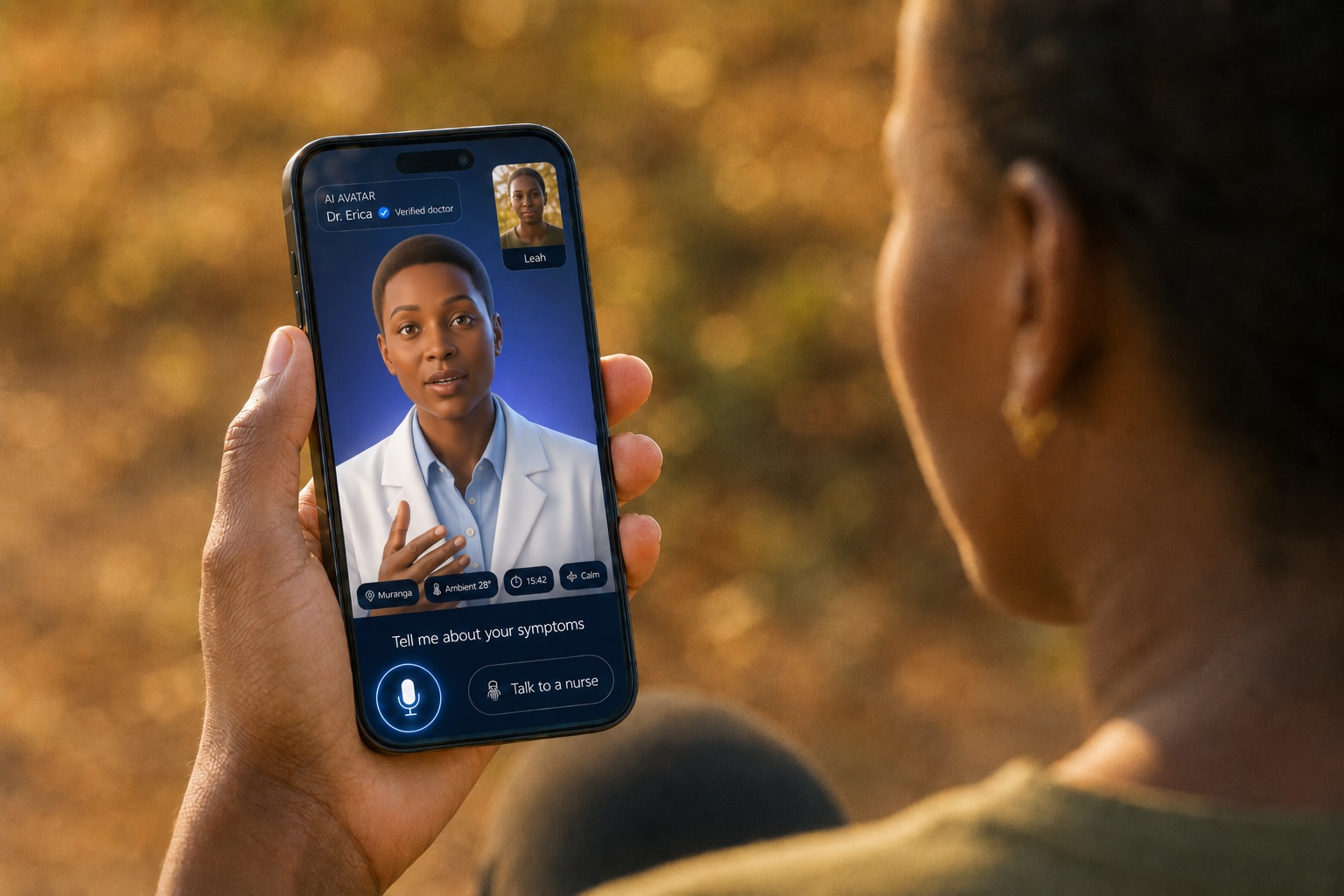
Image: People’s Doctor
- Across sub-Saharan Africa, shortages of health workers, high costs and long distances continue to limit access to care.
- Kenya’s experience with M-PESA shows how digital infrastructure can reorganize access to essential services, including healthcare.
- A mobile phone-based health model being prepared for testing in Kenya combines AI-supported care with citizen-controlled data.
Across sub-Saharan Africa, seeing a doctor still depends heavily on where you live and what you can afford.
The World Health Organization projects that its African Region will face a shortage of nearly 6 million health workers by 2030. More doctors, nurses, clinics and investment are essential to improving access to healthcare.
But even with greater investment, another question remains: could digital infrastructure change the way people first enter and move through the health system?
Kenya has confronted a similar access problem before, in finance.
What healthcare can learn from M-PESA
When M-PESA launched in Kenya in 2007, it enabled people to send and store money using a mobile phone without first needing access to a conventional bank branch. M-PESA now has more than 40 million customers in Kenya alone, and over 70 million worldwide, and expanded far beyond simple money transfers.
Its significance was not simply that banking became digital. The mobile phone became a new entry point to financial services.
Healthcare is different. A phone cannot perform surgery or deliver a baby, and artificial intelligence (AI) cannot replace a trained clinician. But could the mobile phone become a new front door to healthcare?
An initiative supported by Denmark’s Ministry of Foreign Affairs is bringing together People’s Doctor, telecom operators and healthcare providers, alongside prospective research collaboration with Danish and Kenyan universities, to prepare a test of that idea in Kenya.
The model is broader than a health chatbot. Built on shared infrastructure for AI and data governance, it connects a voice-first entry point for citizens with digital support for healthcare professionals, a governed research environment and a proposed wallet layer for consent and value-sharing.
A person could describe symptoms by voice through a mobile phone, receive basic guidance and be connected to a healthcare professional when clinical judgement is required. Clinician-facing tools could support documentation and follow-up, while clinical decisions remain with healthcare professionals.
“What matters is the continuity,” says Lars Munch Johansen, co-founder of People’s Doctor. “The same system can support the first contact with healthcare, the clinician’s work and the follow-up afterwards. With the citizen’s consent, that journey can also generate data that may be useful for research and potentially create value for the health system.”
When a health journey becomes a data journey
Repeated use could create a longitudinal picture of what happens between consultations, including reported treatment adherence, changes in symptoms, further help-seeking and outcomes.
For conditions such as diabetes or HIV, that continuity can be particularly useful for research, says Jens Søndergaard, Professor, General Practitioner and Clinical Pharmacologist at the University of Southern Denmark.
“A consultation gives us a snapshot. Longitudinal data can show more of what happens between those snapshots, but its research value will depend on the quality, completeness and representativeness of the data,” he explains.
At population level, aggregated patterns could also contribute to earlier disease surveillance. Africa Centres for Disease Control and Prevention (CDC) is already testing other forms of digital data, including online and mobile signals, to strengthen infectious-disease monitoring.
But it is the possible economic value of longitudinal data that makes the Kenyan experiment unusual.
Can research value flow back into healthcare?
Health data has value beyond individual treatment, helping researchers understand disease, compare outcomes and study how treatments work outside controlled trials. There is already a precedent for charging for controlled access to such data.
In England, approved researchers can access National Health Service (NHS) patient data through secure data environments, where the data do not leave the controlled environment. NHS pricing includes data provision, curation and a “value share”. Government policy also states that the NHS should share in the value created by its data.
The Kenyan proposal goes one step further: could some of that value flow back to the people whose health journeys helped create it, and help finance the care they rely on?
Under the proposed model, approved researchers, universities or life science companies would not buy individual medical records. Instead, they could pay for research services, analysis or access to appropriately governed data environments that keep individual data secure within a trusted and privacy-preserving framework.
At the centre of the model is what the project describes as citizen data sovereignty: citizens would decide whether information from their health journeys could be used for approved research.
The proposed wallet mechanism is intended to make those permissions manageable and visible. If research generates financial value, it could eventually help direct part of that value back into care, for example by helping participating citizens cover treatment, medicines, prevention or other health costs.
Crucially, this is intended as a value-sharing model: access to essential healthcare should not depend on agreeing to research use of personal health information. Nor is research income assumed to finance the system on its own. It remains unproven whether such income will be large enough to meaningfully subsidize care, and the wider model also envisages contractual revenue from healthcare providers, county governments and other partners.
The choices around consent, access and data use will also have to operate within Kenyan law. The country already has a national legal framework for digital health, including requirements around data governance, security, interoperability and appropriate use and sharing.
Murang’a will test the whole loop
The model is now set to move from concept to practice in Murang’a County in central Kenya.
Murang’a is not starting from scratch. Working with Paratus Kenya and using Starlink satellite connectivity, the county has been upgrading connectivity across its 170 public health facilities to support telemedicine, digital records and other digital health services.
That foundation makes Murang’a a particularly relevant place to test AI-supported access, longitudinal data and research based on citizen-controlled data. The project design treats Murang’a less as a deployment site than as a living lab. Local healthcare professionals are expected to help shape and validate the clinical system, while Kenyan research institutions would co-design research questions.
The practical questions are straightforward: Will citizens use a voice-first health service? Does it support clinical work and reduce pressure on healthcare workers? Is the resulting data useful enough for high-quality research? And can research value become meaningful enough for a share to flow back into care?
The evaluation design recognizes that one county cannot establish whether the model will generalize across Africa, and that neutral or negative findings will matter alongside successful ones.
“For us, the question is not whether we can introduce more technology,” says Gatacha Godfrey, Director of Health Products and Technologies at Murang’a County.
“It is whether the technology improves access, supports our health workers and creates value that benefits the people whose participation makes the system possible.”
From mobile money to mobile health?
The lesson from M-PESA was not simply that a service could become digital, but that technology could create a new route into a system that many people struggled to reach. Healthcare is more complex, and no digital platform can replace the clinics, health workers and investment that remain essential.
The Kenyan experiment will test whether the phone can play a similar connecting role, linking first contact and clinician support with citizen-controlled data and research value that could flow back into care.
Having a doctor in your pocket may still sound ambitious. But if digital health can shorten the distance to medical advice and citizen-controlled health data can help lower the cost of care, the mobile phone could once again become a gateway to a service that millions have struggled to reach.
Don't miss any update on this topic
Create a free account and access your personalized content collection with our latest publications and analyses.
License and Republishing
World Economic Forum articles may be republished in accordance with the Creative Commons Attribution-NonCommercial-NoDerivatives 4.0 International Public License, and in accordance with our Terms of Use.
The views expressed in this article are those of the author alone and not the World Economic Forum.
Stay up to date:
Africa
Related topics:


Forum Stories newsletter
Bringing you weekly curated insights and analysis on the global issues that matter.


