How to transform a fossil fuel business for the energy transition
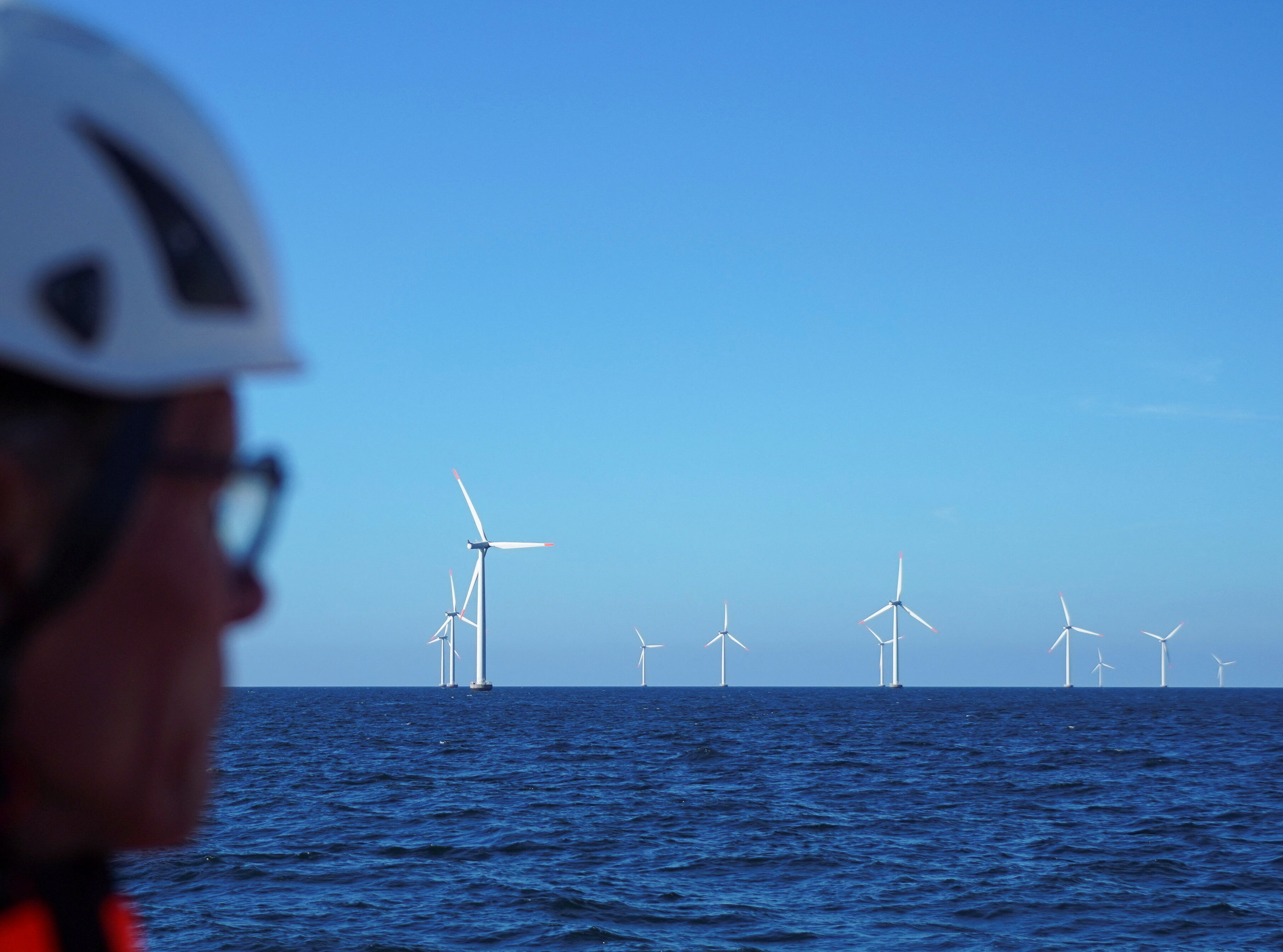
Energy companies can leverage opportunities of the clean economy to drive competitiveness, strategic autonomy and sustainability. Image: Reuters/Tom Little
- In an era marked by uncertainty, Europe can reinvent its industrial future by cutting its fossil fuel dependency and increasing its clean energy production.
- An ambitious, resilient and sustainable green transition requires energy firms to rethink not just what they produce but who they are as organizations.
- Ørsted and Moeve offer lessons on transforming fossil fuel-based businesses and managing the opportunities and challenges of the clean economy.
Faced with geopolitical uncertainty, energy security concerns and growing impacts of climate change, Europe has an opportunity to reinvent its industrial future by reducing its fossil fuel dependency and increasing its own production of clean energy.
Yet a true transition requires more than marginal steps towards diversification. At its most ambitious, it means deep transformations by companies rethinking not only what they produce, but who they are as an organization.
The stories of Ørsted and Moeve offer two such examples of how this can be done, with their experiences providing valuable insights on transforming fossil fuel-based businesses into ones built around the opportunities of the clean economy, while navigating its challenges.
Forging a new identity
Large-scale transformation begins with the conviction of a fundamentally different future and requires leaders willing to make long-term bets before markets are fully mature. For Ørsted and Moeve, this meant not simply adapting their business models but also radically transforming themselves to create entirely new markets for tomorrow’s energy system.
Once among Europe’s most coal-intensive utilities, Ørsted (known as DONG Energy until 2017) has undergone a rapid and far-reaching decarbonization journey to become a world leader in offshore wind.
Its generation mix has evolved from being 85% fossil-fuel based in 2006 to being over 99% renewable today, after a decisive exit from upstream oil and gas and coal generation. Throughout, Ørsted has continued to increase its operating profits while reducing the intensity of its Scope 1 and 2 emissions by more than 98% since 2006.
Spanish energy company Moeve (formerly Cepsa), has recently embarked on a similar transformation to become a producer of green hydrogen and second-generation biofuels, having already sold over 70% of its oil production business and investing up to €8 billion ($9 billion) in its 2030 transition strategy.
In 2008, then-CEO Anders Eldrup set Ørsted on a new path, driven by the conviction that renewable energy, not fossil fuels, would power the next era of growth. Today, CEO Rasmus Errboe is continuing that journey, with offshore wind at the heart of Ørsted’s strategy.
“By completing our green transformation from fossil fuels to renewables, Ørsted has shown that rapid large-scale decarbonization is possible. At a time when energy security, competitiveness, and decarbonization are defining challenges for Europe, accelerating the deployment of renewable energy has never been more important," says Errboe.
In 2022, Moeve CEO Maarten Wetselaar set the company on a new course through its Positive Motion strategy, identifying the Iberian Peninsula as an optimal location to build one of Europe’s most competitive hubs for green molecules, which are produced from green hydrogen or renewable biofuel sources.
For both, the new direction was as much a strategic and financial imperative as an environmental one.
“Our transformation is built on a simple conviction: our business will be more valuable in the future if we provide integrated solutions to Europe’s existential competitiveness, security and decarbonization challenge,” explains Wetselaar.
Becoming catalysts for Europe’s energy transition
Alongside solar, wind is a major pillar in Europe’s drive for energy independence, affordability and sustainability. In 2025, it was the EU’s second-largest source of electricity, generating roughly 18% of total power, up 30% from 2014.
Once a niche technology, offshore wind is today a key pillar of the transition, delivering abundant clean power while reducing system costs and fossil-fuel dependency.
Ørsted’s experience illustrates how early investment in an emerging technology can build capabilities that become strategically valuable as markets mature. Having built the world’s first offshore wind farm, Vindeby in Denmark, in 1991, its portfolio will soon reach 18.3 GW of offshore wind capacity, enough to power the equivalent electricity consumption of approximately 31 million people.
However, renewable electricity alone cannot fully decarbonize transport and materials industries that require high-temperature heat and energy-dense fuels as feedstock. This is where green molecules are emerging as a critical pillar of the transition.
In Europe alone, green molecules could reduce dependence on imported energy by half by 2040 and replace up to 50% of current fossil fuel demand by 2050, accounting for approximately one-third of the EU’s energy mix by 2050.
That is driving Moeve’s transformation, which is building the largest green hydrogen project in Europe’s energy sector – Andalusian Green Hydrogen Valley – and southern Europe’s largest 2G biofuels complex to produce sustainable aviation fuel and renewable diesel.
Together, these projects illustrate Moeve’s strategy to enable the transition of heavy industry, transport and chemical sectors. Abundant renewable energy provides the foundation to make these projects more competitive.
Realizing ambition and navigating uncertainty
Undertaking large-scale transformations requires more than just ambition. Capital is one of the defining challenges: investors, lenders, employees and other stakeholders must trust the long-term value of the transition plan, even when market conditions are difficult.
For Moeve, support from its two private shareholders, Mubadala and Carlyle, was crucial to the strategy formulation, while implementation has required stronger cross-team integration and persistence, as external factors such as permitting, grid access, financing and regulation evolve amid shifting geopolitics.
Long-term bets into nascent markets carry risks, and transitions are rarely linear. As a public company, Ørsted’s experience illustrates that the transition requires sustained access to capital and careful management of project economics, particularly as supply-chain costs, interest rates and market conditions change.
Only by properly managing these can companies build the confidence needed to mobilize investment at scale. Confidence also depends on a stable and predictable policy environment. Frameworks such as the European Green Deal, EU Emissions Trading System (ETS), REPowerEU and the Joint Offshore Wind Investment Pact for the North Seas provide a solid foundation for planning, investing and scaling new supply chains, while regulatory uncertainty and permitting bottlenecks can slow progress and increase costs.
The power of partnerships to accelerate progress
For a clean transition, companies need to act beyond their own operations and build broader ecosystems. Through initiatives like the Alliance of CEO Climate Leaders or the First Movers Coalition (FMC), Ørsted and Moeve are working with peers to raise collective ambition and accelerate progress.
To decarbonize value chains, close collaboration with suppliers and partners is essential. Ørsted has partnered with Dillinger to secure access to low-emission steel for monopile foundations and is investigating offshore charging to electrify vessel logistics, based on a strategy outlined in The Next Zero white paper.
Through its engagement in FMC, Moeve’s contract for ultra-efficient chemical tankers that can be powered by electric generators and low-carbon fuels is another example of how companies can leverage procurement to simultaneously reduce emissions while creating markets for new solutions.
The experience of both companies highlights how business transformation is never a solo endeavour and that collaboration is critical, with the future of the transition relying on it.
Don't miss any update on this topic
Create a free account and access your personalized content collection with our latest publications and analyses.
License and Republishing
World Economic Forum articles may be republished in accordance with the Creative Commons Attribution-NonCommercial-NoDerivatives 4.0 International Public License, and in accordance with our Terms of Use.
The views expressed in this article are those of the author alone and not the World Economic Forum.
Stay up to date:
The Net Zero Transition

Forum Stories newsletter
Bringing you weekly curated insights and analysis on the global issues that matter.
More on Energy TransitionSee all

Hanane Mourchid, Jamil Wyne and Olivia Zeydler
October 6, 2026


