How organizations can publish knowledge that AI can use responsibly

Publishers can help AI tool developers ensure search results are correct by providing more information alongside their research. Image: Unsplash/VitalyGariev
- Organizations such as national statistics offices publish data that can inform the searches people do online using traditional and, increasingly, AI tools.
- But this data can be cited in an AI search answer even when the evidence does not support the conclusion.
- Publishers can help developers check AI-generated answers by providing definitions, limitations and example questions alongside their evidence.
In a recent pilot connecting an artificial intelligence (AI) assistant to Uruguay’s public energy data, the system attributed a data change partly to climate factors. The aim of the pilot was to develop AI search tools that allow people to ask natural‑language questions and get answers that are traceable back to official datasets. But according to the Open Knowledge Foundation’s account of the pilot, the dataset the AI assistant was using contained no climate data to support its explanation of the change.
Whether you’re using an AI tool to assess a policy or plan an investment, explanations can matter as much as figures. A citation will help you find evidence, but it does not establish that every claim in the AI tool’s answer follows from that evidence.
This creates a challenge for organizations publishing research, data and guidance such as the International Energy Agency, the UK’s Office for National Statistics or the U.S. Bureau of Labor Statistics. Their work can appear in an AI tool’s answer that omits important limitations or adds an explanation the evidence does not support. Being accessible and cited does not fully measure whether the organization’s knowledge is being used correctly.
Organizations that publish evidence can help companies building and operating AI tools to check how those tools use their data. Alongside a dataset or study, they can publish test questions with notes explaining what the evidence supports, where limitations apply and what would require additional evidence.
This would give developers practical tests to show whether their AI systems represent the material faithfully, while making failures easier for publishers and users to identify.
Context and consistency for AI tools
A qualification buried in a report may never reach an AI system that only retrieves a table from the report. When organizations make a dataset available to AI software, its definitions and limitations should be available through the same route.
When an AI tool requests an employment figure, for example, the response should identify the population and period covered, flag whether the figure is provisional and link to the methodology used to calculate that figure. The AI tool may not reliably reconstruct essential context from scattered documents.
Research requires similar care. A summary can accurately report a study’s result while misleading readers if it omits the population or setting in which the findings apply.
Knowing what a statistic measures does not establish why it might have changed. Definitions distinguish electricity generation from generating capacity, but explaining a change in generation requires further evidence. An organization may be the authoritative source for a statistic without being the final authority on its causes.
That’s why companies building and operating AI tools should check whether the evidence supports the claims those tools make. Further interpretation may be justified by other sources, which should be identified. Where evidence is insufficient, the answer should acknowledge what remains unknown.
Organizations also need to maintain consistency when it comes to the information they make available to people and software. Under an initiative created by the World Economic Forum and Cambridge SupTech Lab, the Bank of Mauritius worked with technology provider TSO on a proof of concept that converted regulatory information into structured data. One workflow could publish readable guidance, software interfaces and PDFs.
By using a common source, organizations can update what people read and what software retrieves together. Otherwise, a correction on a website may leave an older machine-readable version in circulation. Earlier versions should remain identifiable in case they are needed for historical questions, of course.
Testing how information is used by AI
An organization could start with a widely used dataset or study and publish a few example questions to test AI tools, with notes explaining what an answer should include and what the evidence cannot establish.
Questions already received by the organization are a useful starting point. In the previously mentioned Uruguay and Brazil pilots, for example, the Open Knowledge Foundation reports that partners’ frequently asked questions informed testing and helped refine guidance for the AI tools.
These questions can test whether AI tools retrieve the right information. But their evaluation should go beyond whether a system returns the correct number. They should also check whether its answer includes important limitations, such as a study covering only one age group, and acknowledge when the evidence cannot answer the question.
These example questions provide a starting point for evaluation, but developers would also need to test unfamiliar questions:
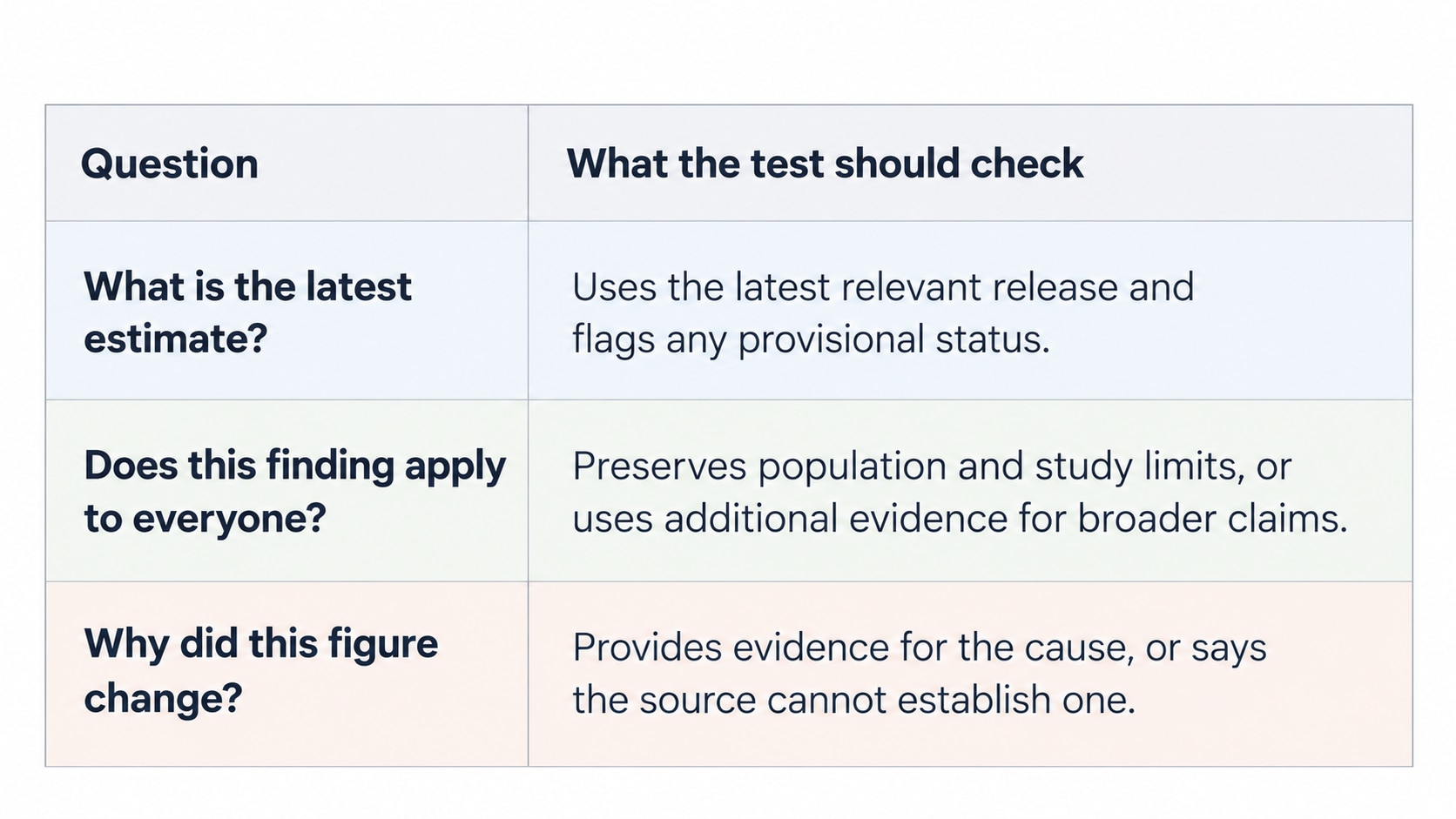
The questions should help check whether AI tools’ answers are supported by evidence, without requiring agreement with an organization’s preferred interpretation. They should also allow answers to draw responsibly on additional sources.
Co-operation and feedback on AI answers
A World Bank background paper for the 2026 UN Statistical Commission recommends cooperation and feedback between statistical producers, redistributors and AI developers. Publishing test questions could give that cooperation a practical focus.
It would help publishers maintain sources and explain limitations. And developers would be able to evaluate how their AI systems retrieve and interpret the material. Diagnosing an error may require input from both – a publisher can check that a date was supplied, but may need a developer’s help to establish whether the system retrieved and used it correctly.
Smaller organizations should not need to develop individual partnerships with every company operating an AI tool. Sector bodies could organise shared tests, including questions in locally relevant languages. These companies should offer a clear route for reporting recurring misinterpretations.
The purpose of publishing research and evidence is to help people understand an issue. Checking whether AI-generated answers accurately represent that evidence should become part of the publishing process.
Don't miss any update on this topic
Create a free account and access your personalized content collection with our latest publications and analyses.
License and Republishing
World Economic Forum articles may be republished in accordance with the Creative Commons Attribution-NonCommercial-NoDerivatives 4.0 International Public License, and in accordance with our Terms of Use.
The views expressed in this article are those of the author alone and not the World Economic Forum.
Stay up to date:
Data Policy


Forum Stories newsletter
Bringing you weekly curated insights and analysis on the global issues that matter.
More on Artificial IntelligenceSee all

John Halamka, M.D., M.S., Amber Nigam and ARPAN SAXENA
October 6, 2026


