Why brain-healthy thinking can prevent AI burn-out

Recovery time is mandatory while working with AI. Image: Unsplash/Luke Aram
- Neuroscience offers a practical way to understand the cognitive demands on our brains imposed by working with AI.
- With prolonged AI interactions challenging both cognitive skills and mental energy levels, workers are at real risk of 'brain fry'.
- Six key actions can help increase productivity and protect brain health in the age of AI.
Today's workforce is navigating a perfect storm of geopolitical uncertainty, economic pressure, demographic change, climate-related disruption and accelerating technological transformation. These forces are reshaping how people work, learn, make decisions and relate to one another. They are also placing growing demands on the brain, with consequences for mental health, productivity, creativity and organizational resilience.
For business leaders, this makes brain health more than an individual well-being concern. It is an organizational capability and a strategic condition for people to perform, adapt and make sound judgements over time. Organizations that protect mental resilience and design work around human cognitive limits will be better placed to sustain performance through uncertainty and change.
Neuroscience offers a practical way to understand this challenge. It can help leaders see how attention, learning, decision-making, stress and recovery shape performance, and how workplace systems can either strengthen or deplete the mental resources on which performance depends.
Among the forces transforming work, artificial intelligence is especially consequential. AI is rapidly changing the tasks people perform and the way they allocate attention, evaluate information and exercise judgement. It therefore provides a useful lens through which to examine a wider business imperative: How can organizations adopt powerful new technologies while strengthening human capability and protecting the brain health that makes sustainable performance possible?
Why AI makes brain health a business issue
The World Economic Forum (WEF) 2026 report, The Human Advantage: Stronger Brains in the Age of AI, estimates cost-effective brain-health interventions could generate up to $6.2 trillion in cumulative GDP gains by 2050. Brain health is too economically significant to remain a well-being side programme.
A general-purpose “cognitive machine” is entering everyday work at scale; generating content, analyzing information, identifying patterns and recommending actions. AI adoption is not simply a technology challenge; it is placing unprecedented cognitive demands on the human brain. As AI takes over more routine cognitive work, the human role shifts toward higher-load activities. If these demands are sustained without enough lower-load periods and recovery, the brain can remain under elevated cognitive pressure for longer.
Additionally, an analysis of WEF’s Future of Jobs Report 2025 suggests eight of the top 10 core skills employers need today (80%) depend heavily on what we call cognitive skills such as: analytical thinking; resilience, flexibility and agility; leadership and social influence; and creative thinking.
Therefore, to sustain business performance, cognitive skills and capacity need to be protected and enhanced.
Two dimensions of cognitive capacity
This challenge has two interacting dimensions:
- Brain Capability. The effectiveness and efficiency of related cognitive skills (such as analytical and creative thinking) when undertaking tasks in “uncharted waters” and in pressure situations, including the mental effort required.
- Brain Battery. A practical metaphor for the mental reserves available to sustain effective thinking over time.
In practical terms, Brain Capability provides a foundation for learning agility – the ability to learn, adapt and apply new approaches as situations and technologies continually change.
Brain Capability also includes focused, conceptual, strategic, abstract and intuitive thinking. These cognitive skills reflect subconscious neurological routines predominantly shaped through childhood activities, games, hobbies, etc. – our happy accidents of childhood neurological programming.
With AI-enabled work, these skills shape attention, problem-framing, challenging assumptions and how critical outputs (including potential AI hallucinations) are evaluated.
Why traditional AI training is necessary – but not sufficient
Most AI training in the workplace focuses on language-based conscious learning: what the tool does, how to prompt it, and which policies apply. This knowledge is necessary. But knowledge is not behaviour.
A manager can understand policy and still accept a plausible AI hallucination. An executive can know AI should augment judgment and still over-delegate thinking. A trained team can still be exhausted by the oversight requirements AI creates. Research shows that over-reliance on AI can reduce employees’ cognitive effort, weaken independent evaluation of information and increase the likelihood that they accept AI recommendations without sufficient scrutiny.
Brain Capability cannot be developed through language-based explanation alone. It requires experience-dependent neuroplasticity: Repeated practice that changes neural systems. Anders Ericsson’s guided Deliberate Practice approach targets a specific skill through expert guidance on the correct approach, stretch practice, timely feedback and progressively harder tasks, helping performance become more fluent and less cognitively demanding.
The hidden risk: AI brain fry
Mental reserves are not fixed. They change with sleep, stress, health, workload and time of day. Even highly capable people become vulnerable when reserves are low. Lower Brain Capability also means the same task consumes more mental energy and time.
A 2026 Harvard Business Review study on “AI brain fry” of 1,488 full-time US workers found high AI oversight was associated with 14% more mental effort, 12% more fatigue and 19% more information overload than low oversight.
Brain Capability and mental reserves (Brain Battery) interact as four dynamic cognitive states:
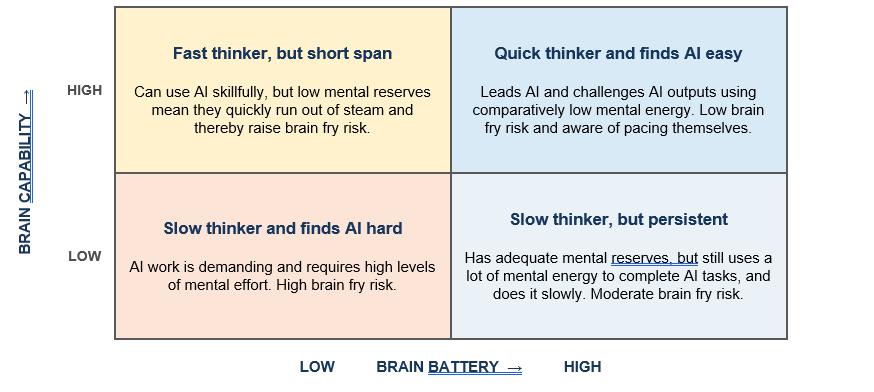
If the required cognitive complexity and the available brain energy mismatch too often, overload occurs sooner and more frequently, while effective Brain Capability temporarily declines. This becomes a brain health issue, not simply performance. Repeated overload can contribute to chronic stress and burn-out.
Recovery is part of performance
Leaders often treat breaks as lost productive time. In intensive AI work, that can be counterproductive. Brief breaks or lower-demand activity can slow depletion, but they do not replace sleep.
In one controlled study, six hours or less sleep per night for 14 days produced cognitive performance deficits equivalent of up to two nights of total sleep deprivation. Participants were largely unaware of the decline.
Six shifts to reduce cognitive overload and protect brain health in the AI era:
1. Enhance people’s Brain Capability: Complement one-off AI training with guided Deliberate Practice to strengthen the cognitive skills needed for adaptation and making better decisions.
2. Protect people’s Brain Battery: Stop treating attention and mental reserves as unlimited. Create focused work periods, meaningful recovery breaks and boundaries that reduce sustained cognitive overload.
3. Track cognitive demand and make proactive recovery recommendations: Monitor intensive AI use and fatigue signals, with privacy safeguards. Then recommend recovery options before overload occurs.
4. Design AI work systems to enhance human performance: Let AI handle repetition and processing while people focus on questioning, interpreting, creating, evaluating, judgement and deciding.
5. Join the systems: Connect health, learning, technology, risk and business leaders, measuring sustainable performance alongside AI adoption.
6. C-Suite alignment: Ensure the CEO, CFO, CHRO and CHO understand cognitive capacity (Brain Capability and Brain Battery) and its role in supporting mental well-being, organizational health and sustainable business performance.
How the Forum helps leaders make sense of AI and collaborate on responsible innovation
AI will keep becoming more capable. The challenge is to strengthen human capability without exhausting the mental reserves that sustain it. Developing Brain Capability while protecting the Brain Battery can reduce overload, protect brain health, and develop more resilient employees.
Don't miss any update on this topic
Create a free account and access your personalized content collection with our latest publications and analyses.
License and Republishing
World Economic Forum articles may be republished in accordance with the Creative Commons Attribution-NonCommercial-NoDerivatives 4.0 International Public License, and in accordance with our Terms of Use.
The views expressed in this article are those of the author alone and not the World Economic Forum.
Stay up to date:
Artificial Intelligence
Related topics:


Forum Stories newsletter
Bringing you weekly curated insights and analysis on the global issues that matter.
More on Wellbeing and Mental HealthSee all

Nga Leopold
October 8, 2026


