These are the top 10 countries for travel and tourism in 2026

Japan's strategy to expand tourism beyond its major destination hubs has paid off. Image: Unsplash/Jezael Melgoza
Ramya Krishnaswamy
Head of Institutional Communities; Executive Committee Member, World Economic Forum- As global arrivals hit a record 1.5 billion, the World Economic Forum’s latest Travel & Tourism Development Index, produced in collaboration with Zurich Insurance Group, reveals a sector actively thriving.
- Emerging markets across Asia-Pacific and the Middle East are accelerating competitiveness at twice the pace of established tourism destinations.
- Beyond tourism numbers alone, the index examines why culture, natural assets and infrastructure are increasingly decisive for lasting growth.
People are travelling. A lot. Despite ongoing geopolitical, economic and environmental challenges, a record 1.5 billion tourist arrivals were registered globally in 2025, with around 307 million people travelling internationally in just the first quarter of 2026 – a clear sign that the travel and tourism (T&T) industry has not only recovered from the pandemic downturn but is actively thriving.
Indeed, international tourist arrivals in 2025 were up 5% compared to 2024 and 4.4% above 2019 levels. The sector contributed a record $11.6 trillion to global GDP last year, up 4.1% on 2024 and over double compared to 2019 figures. And in terms of jobs, T&T supported 366 million worldwide in 2025, representing around one in every ten jobs globally.
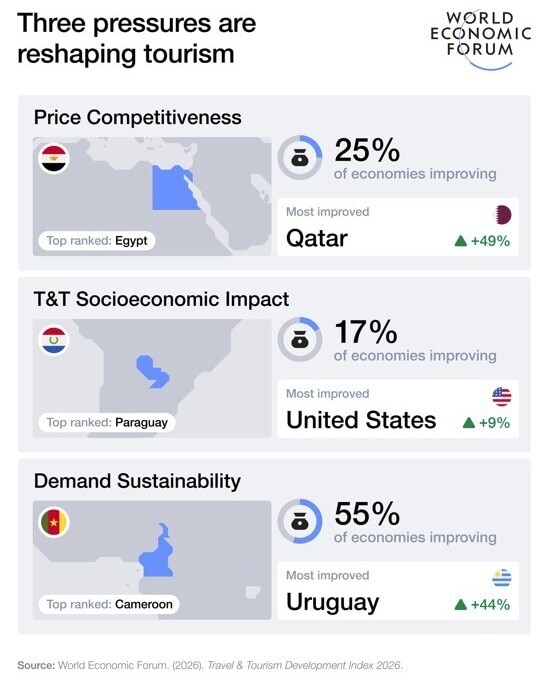
But while the industry overall is in good health, some regions and markets are seeing stronger growth than others, and growth itself is becoming a challenge, as the World Economic Forum's latest Travel & Tourism Development Index (TTDI), produced in collaboration with Zurich Insurance Group, makes clear. The Index draws on nearly two decades of Forum benchmarking of the sector, measuring where T&T is becoming more resilient and sustainable, and also identifying the gaps that industry, government and investors need to address.
While the top 10 countries merit closer consideration, it's worth noting that between 2024 and 2026, the vast majority (92%) of the 110 economies ranked in the TTDI improved their score, and average scores increased by 2%, the fastest pace of improvement since 2019.
The top 10 countries
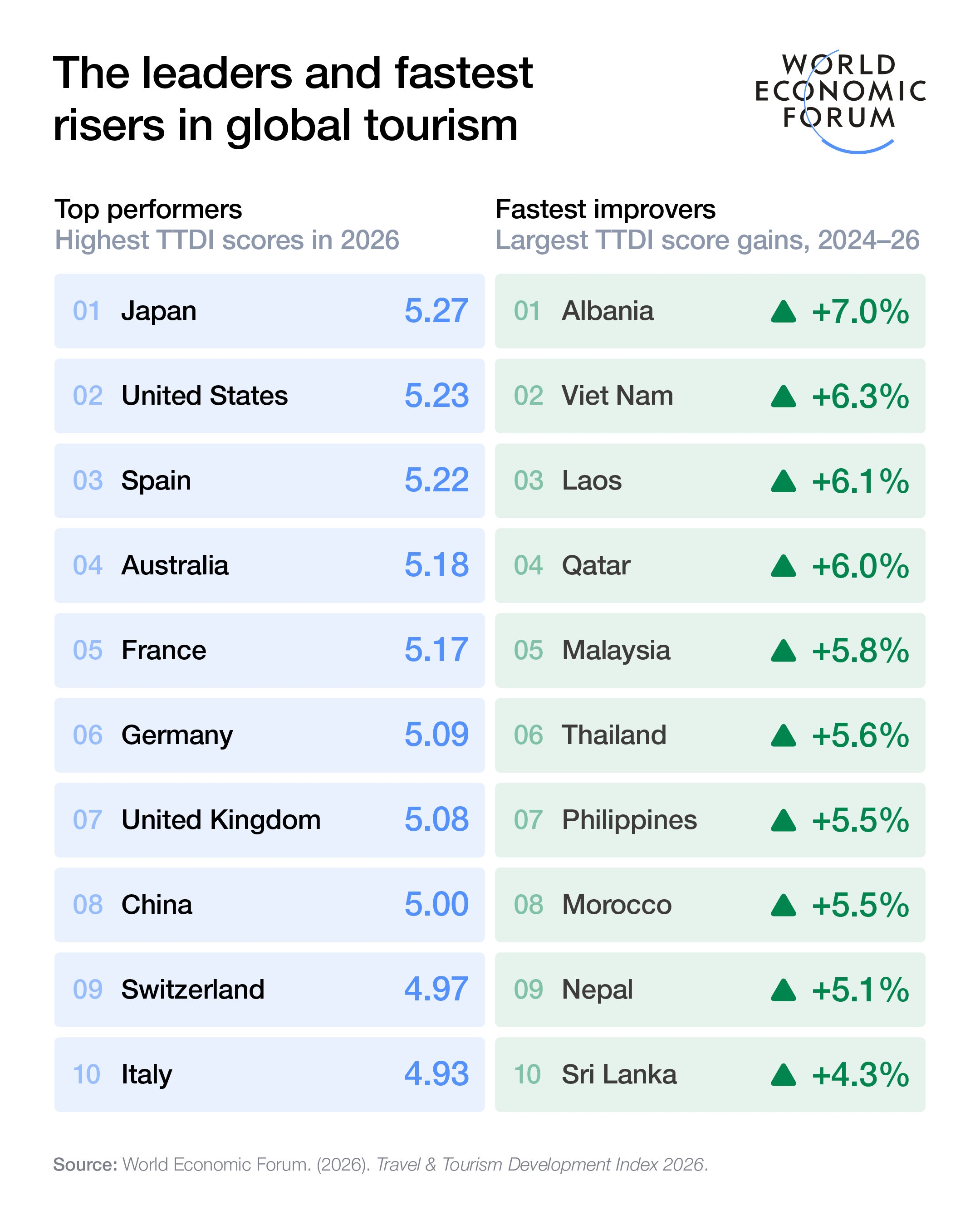
The best-performing countries in the index have not actually changed since the last TTDI in 2024. But there has been some repositioning among them. Japan has moved up two places to take the number one slot from the United States. Australia has also been bumped up two notches to take fourth place behind Spain. Although China remains at number eight, it outpaced the global average growth rate.
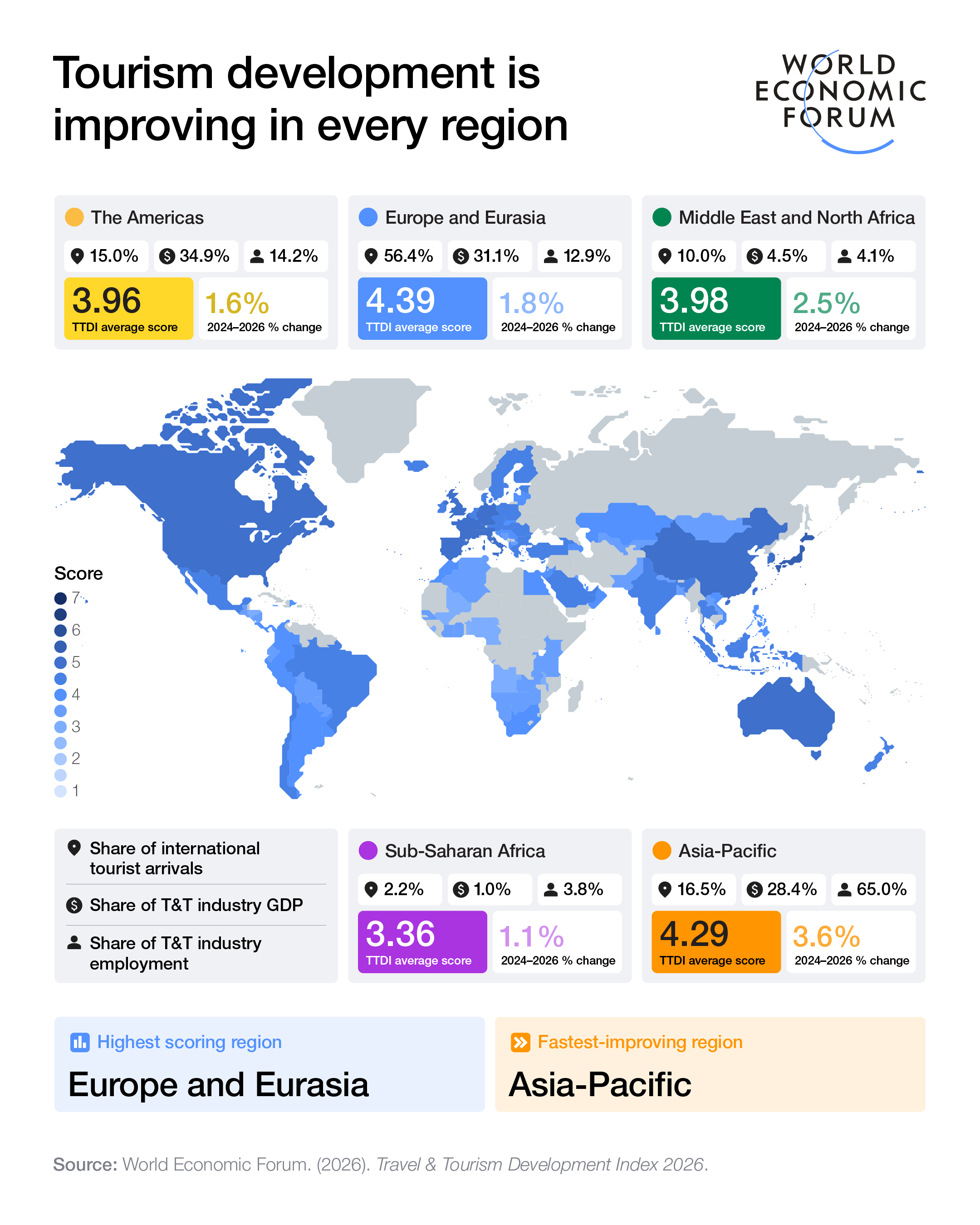
These shifts reflect stronger demand and greater capacity in Asia-Pacific (APAC), according to the TTDI report, which cites the region's continued recovery from its delayed post-pandemic reopening as a key driver in its improved scores.
So how did Japan secure the number one slot this year? The country welcomed a record 42.7 million international visitors in 2025, partly thanks to its diversification efforts. The Japan National Tourism Organization has been working to attract travellers from a wider range of countries while also promoting regional destinations beyond Japan’s major draws, such as Tokyo, Hiroshima and Osaka. And the strategy seems to have paid off. Visitor spending reached $59.7 billion (9.5 trillion yen) in 2025.
With the exception of China, advanced economies account for nine of the top ten positions. And European countries – Spain, France, Germany, the UK, Switzerland and Italy – dominate, reflecting Europe and Eurasia’s position as the highest-performing region overall.
Which are the fastest risers?
In terms of fastest growth, however, other regions have come to the forefront.
Growth was strongest in APAC and MENA (the Middle East and North Africa), with gains of 3.6% and 2.5%, respectively. Seven out of the ten most improved economies came from developing countries in the APAC region, including Laos (+6.1%), Malaysia (+5.8%) and Thailand (+5.6%).
Drilling down further into the data, the TTDI finds that the largest emerging tourism economies have improved their scores more than twice as fast as the top 20 countries since 2019, "benefiting from competitive prices, rich natural assets and more sustainable demand patterns".
In terms of individual countries, Albania was the strongest overall improver, increasing its score by 7% compared to 2024. The TTDI report says that improvements in tourist services and infrastructure, air transport, as well as ground and port infrastructure, have helped Albania "convert growing visitor demand into tourism growth".
Culture leads the way
As the graphic above illustrates, the TTDI is structured around 17 pillars. Countries are measured against each one, to build a picture of their strengths and weaknesses in creating enabling environments for travel and tourism.
Between 2024 and 2026, 14 of these 17 pillars improved overall, with culture coming out on top, followed by gains in tourism infrastructure, as well as air connectivity.
Cultural resources increased 9.6% compared to 2024 figures, with over 95% of economies recording higher scores. The rise is partly down to a global effort to safeguard cultural heritage, says the report, with UNESCO’s World Heritage List increasing from 869 sites in 2019 to 972 in 2026. But it also points to UNESCO’s Intangible Cultural Heritage register, which recognizes festivals, performing arts, craftsmanship and food culture – with the latter alone having become a $16.1 billion gastronomy market.
Natural resources increased by 4.1%, with 96% of countries improving their scores. Growing interest in nature-based travel is helping to expand tourism into more rural areas – and is an opportunity for emerging and developing economies, according to the report. Natural assets like forests and coastlines, as well as wildlife protected areas, are particularly represented by developing countries. Among the 30 highest-scoring economies for natural resources, 20 are emerging or developing economies, mostly located in Latin America and APAC.
But higher visitor numbers do not necessarily benefit countries. The destinations that will do best in the years ahead, the TTDI says, will be those that manage growth carefully, be agile in front of global disruptions while "creating positive socioeconomic and sustainability outcomes for visitors, business and host communities."
License and Republishing
World Economic Forum articles may be republished in accordance with the Creative Commons Attribution-NonCommercial-NoDerivatives 4.0 International Public License, and in accordance with our Terms of Use.
The views expressed in this article are those of the author alone and not the World Economic Forum.
Forum Stories newsletter
Bringing you weekly curated insights and analysis on the global issues that matter.
More on Sustainable DevelopmentSee all

Kelly Ommundsen
September 23, 2026


