How AI and power systems are rewriting each other's rules
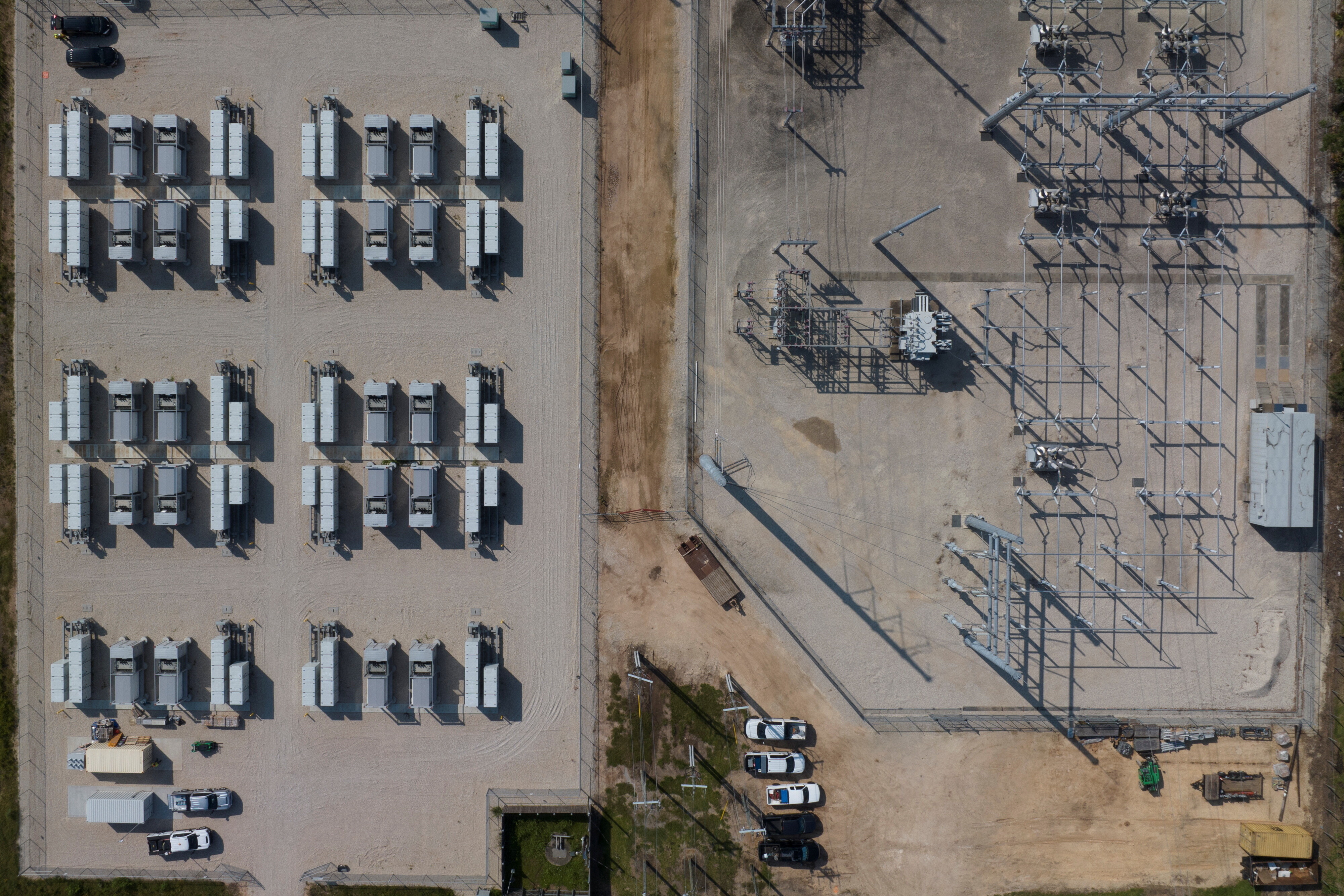
Energy infrastructure, power systems and AI are already becoming interdependent. Image: REUTERS/Adrees Latif
- AI is emerging as a new source of power-system resilience, enabling grids to detect disruption, respond and adapt in real time.
- AI is increasingly entering the operating core of power systems, turning facilities, buildings and storage assets into autonomous energy managers.
- The task now is to build for a world in which intelligence is infrastructure - and in which decisions about AI procurement, grid expansion and energy storage are no longer made in separate rooms.
What happens when two critical infrastructures – AI on the one hand, and our electricity infrastructure on the other – start to rewrite one another's rules? That is the question grid operators, hyperscalers and energy policymakers are now asking.
AI is changing how electricity systems are planned, built and run. Electricity systems, in turn, are setting the boundaries of what AI can become. The grid and the algorithm are no longer separate stories.
This convergence matters because their clocks are out of sync. The International Energy Agency (IEA) estimates that electricity consumption from data centres could roughly double by 2030. But infrastructure buildouts do not move at the speed of software. New transmission lines can take years to permit, finance and build; new AI workloads can arrive in months. That mismatch between infrastructure and computational timescales is becoming one of the defining features of the decade ahead.
The World Economic Forum’s Innovation Playbook for Future Power Systems captures this shift with clarity. What emerges from its case studies is a portrait of three core themes across this mutual transformation:
1. AI is entering the operating core of power systems;
2. Power systems are becoming a binding condition for AI deployment;
3. AI is emerging as a mechanism through which grids absorb shocks.
The future of power will be determined by how intelligently this emerging system is managed. Here’s what you need to know about each theme.
AI in the operating core of power systems
The clearest sign that AI has moved from being a tool for the grid to becoming part of the grid itself is the fading distinction between energy producer and energy user. Industrial facilities, commercial buildings and distributed storage assets are beginning to run continuous optimization loops, deciding when to generate, store, consume or sell electricity.
Take, for example, Envision, a Chinese company that provides wind turbines, energy storage systems and energy management software. Its AI Power System for industrial parks shows what this looks like at the edge of the grid.
“Industrial facilities that were once passive users of electricity are becoming autonomous energy managers, continuously balancing on-site solar, battery storage and grid interaction without compromising production,” Lei Zhang, Envision's Founder and CEO, said.
The implications extend beyond any single facility. When industrial users become active grid participants, the demand side of the electricity system acquires the intelligence that has historically sat mainly on the supply side. The grid gains not just more assets, but more decision-makers: millions of buildings, batteries and industrial sites are able to absorb variability and respond to prices.
Power systems as the foundation for AI deployment
AI's growth, however, is creating a category of electricity demand that existing power systems were not designed to serve. This is thanks to both the volume required, and the character of that volume. AI data centres require power that is highly reliable, increasingly clean and available on timelines that do not match conventional grid-expansion cycles.
The problem is not only that this demand is large; it is that it is arriving faster than the grid can respond.
China-based battery and storage solution provider Hithium is working to address that gap. Their approach pairs long-duration storage at the energy source with a lithium-sodium system at the load side, giving operators grid-scale reliability and millisecond response on deployment timelines of one to two years rather than five to ten. For hyperscalers, that storage – and the ability to scale it up quickly – is becoming a prerequisite for AI deployment at scale.
"AI is scaling faster than power infrastructure can be built. Fast-response storage combined with long-duration flexibility provides the reliability that AI data centre operators require, while enabling co-location of the large renewable capacity that hyperscalers increasingly demand," Dr. Nazar Yi, Hithium Board Member and Vice President, said.
China’s new energy plans for the 15th Five-Year Plan period (2026–2030) reflect this convergence, calling for closer coordination between computing, power and renewable-energy infrastructure, linking “power for AI” with “AI for power”.
AI as a source of resilience
The third current is the least visible and may prove the most consequential: AI as the means by which power systems see trouble, absorb it and recover. As grids carry more variable renewables, and as extreme weather and cyber risks multiply, stability is becoming less a matter of reserve capacity alone and more a question of speed. A system that cannot react fast enough cannot remain stable.
“In the AI era, resilience is no longer defined by backup power alone. It is the ability of energy storage systems to sense, respond and adapt in real time, keeping critical infrastructure operating even as power systems become more dynamic and uncertain,” Dr. Yi said.
The next step is infrastructure with intelligence stitched through it. Human operators work in minutes; AI-enabled systems can detect anomalies, reroute flows and coordinate storage in milliseconds. Such capabilities change the economics of resilience: intelligent protection is becoming more efficient just as outages for supply chains, data centres and financial systems are becoming more expensive.
Mutual dependence is already upon us
These three currents are already interacting and converging. AI systems that manage industrial energy autonomously are also the assets that virtual power plants aggregate. Storage systems designed for data-centre reliability are also buffers for renewable-heavy grids. Resilience intelligence that protects a facility also contributes to the grid-level stability that keeps digital infrastructure online.
That means decisions once made in separate rooms – power purchase agreements, grid expansion plans, cybersecurity protocols and AI procurement – are now interdependent. Technology companies that separate AI infrastructure decisions from energy security create fragility.
Grid operators that plan transmission without modelling AI-driven demand behaviour plan for a load that no longer exists. Policymakers who regulate energy storage for grid stability but not for compute competitiveness miss the system they are actually governing.
The deeper question is no longer whether grids and algorithms will become interdependent. They already are. The task now is to adapt and build for a world in which intelligence is infrastructure.
Don't miss any update on this topic
Create a free account and access your personalized content collection with our latest publications and analyses.
License and Republishing
World Economic Forum articles may be republished in accordance with the Creative Commons Attribution-NonCommercial-NoDerivatives 4.0 International Public License, and in accordance with our Terms of Use.
The views expressed in this article are those of the author alone and not the World Economic Forum.
Stay up to date:
Artificial Intelligence
Related topics:


Forum Stories newsletter
Bringing you weekly curated insights and analysis on the global issues that matter.
More on Energy TransitionSee all

Roberto Bocca
October 2, 2026


