Why are prices still rising? And more top economic stories to read this month
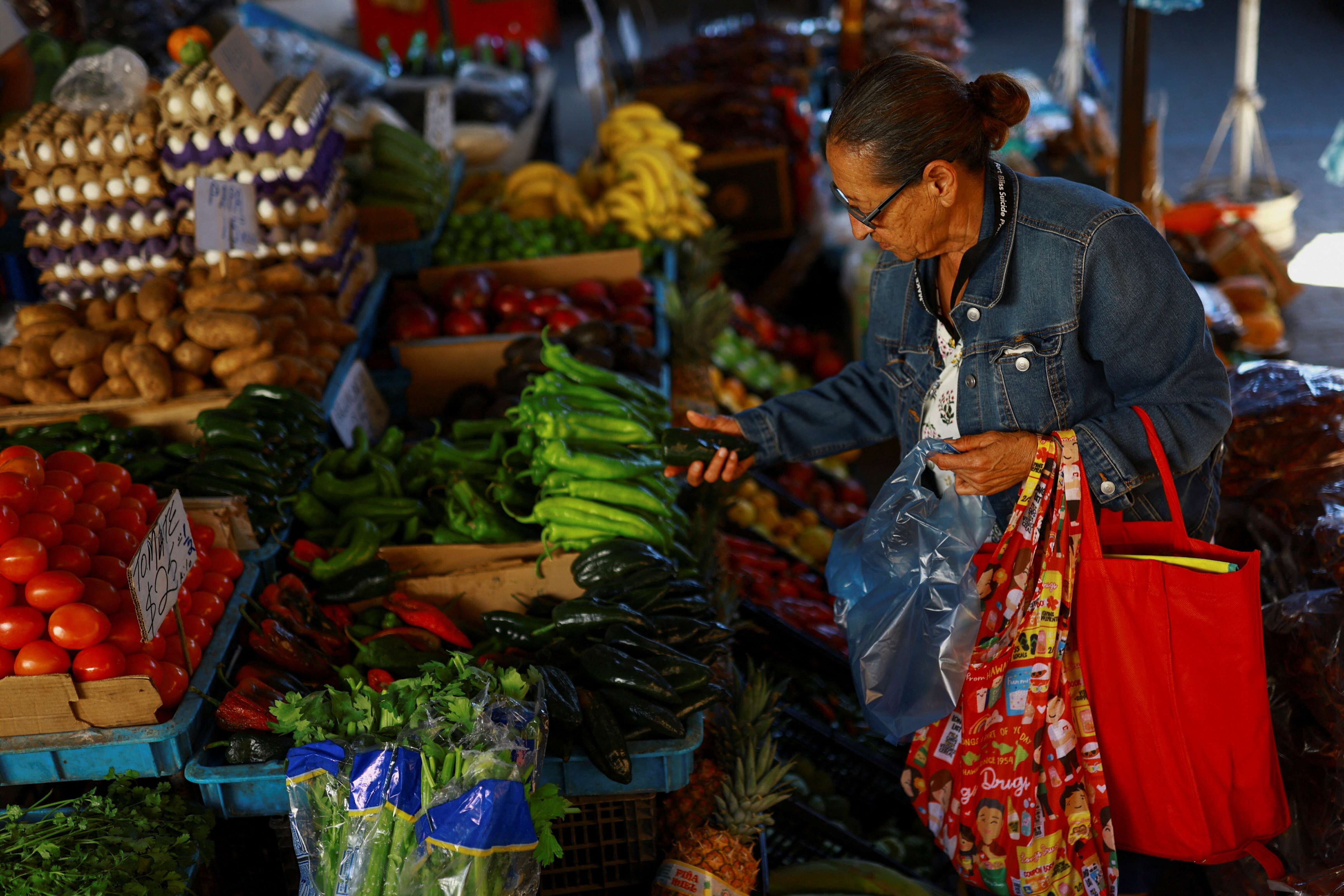
Food prices are rising across the globe. Image: REUTERS/Jose Luis Gonzalez
Philipp Grosskurth
Manager, Economic Growth, Revival and Transformation Insights, World Economic Forum- Your regular round-up of news and analysis on the global economy from the World Economic Forum’s Centre for the New Economy and Society.
- Top stories: Why inflation is proving persistent, whether wages have caught up with higher prices and how uneven growth and widening global imbalances are complicating the policy response.
Inflation has retreated from its post-pandemic highs in many economies, yet households are still facing a rising cost of living. The World Economic Forum’s latest Chief Economists’ Outlook points to further expected pressure ahead: 88% of respondents expect food costs to rise over the next year, 83% expect higher electricity costs and 77% expect transport costs to increase.
These pressures are landing before purchasing power has fully recovered in many economies. At the same time, uneven growth is narrowing the room for governments and central banks to respond, while wider global imbalances are adding to trade and financial tensions.
Why are prices still under pressure?
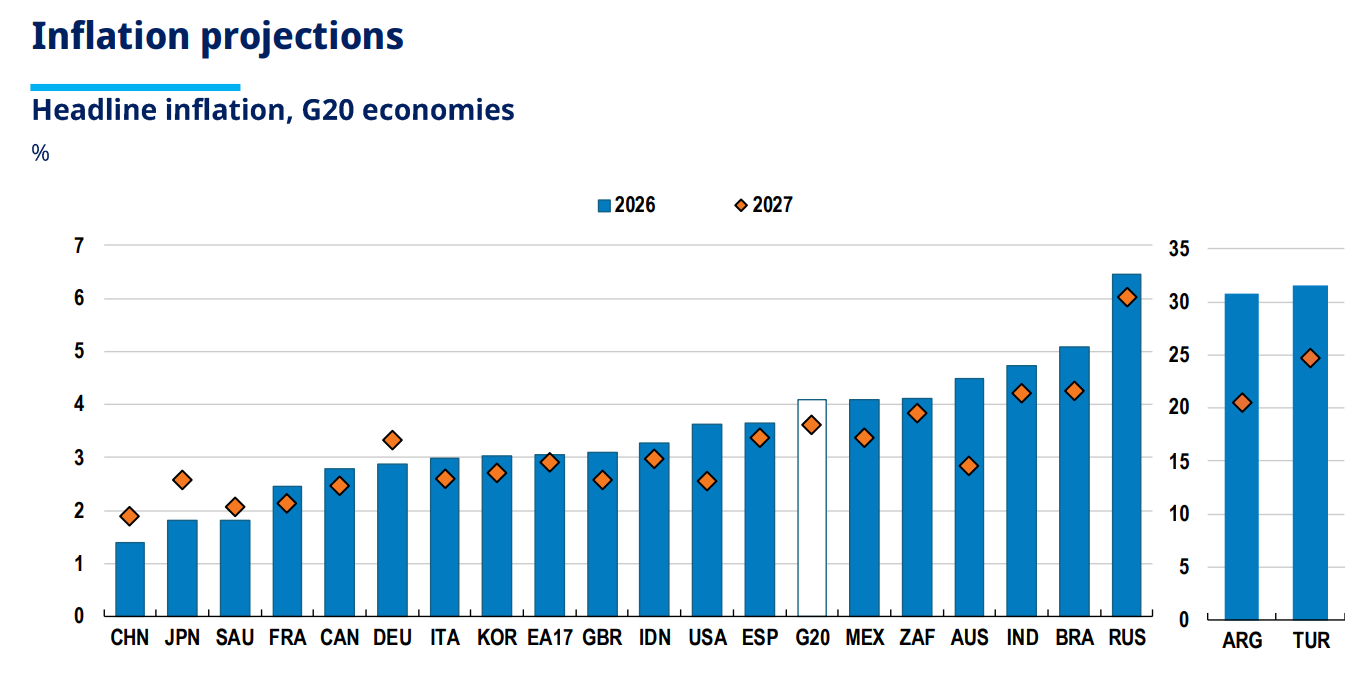
Global headline inflation is projected to rise to 4.7% in 2026 before easing to 4.1% in 2027. Across advanced G20 economies, headline inflation is projected to increase from 2.5% in 2025 to 3.2% in 2026, before falling to 2.6% in 2027, according to the Organisation for Economic Co-operation and Development (OECD). In emerging G20 economies, it is forecast to climb from 4.1% to 4.8%, then ease to 4.3%.
The picture varies significantly between countries. Inflation is projected to fall particularly sharply in Argentina, from 30.8% this year to 20.5% in 2027, and in Türkiye, from 31.5% to 24.7%. It is also expected to ease in Australia, the United States and South Africa, but to rise in Japan, China and Germany.
Food prices are adding to the pressure. The FAO Food Price Index averaged 136.0 points in September, up 1.5% from August and 5.8% from a year earlier. The FAO Cereal Price Index rose by 5.1% month-on-month, while the Sugar Price Index increased by 6.1% and the Vegetable Oil Price Index by 0.9%. The increases reflected a combination of trade and transport disruptions, tighter supply prospects and adverse weather conditions.
Energy markets have also remained sensitive to geopolitical disruption. Brent crude fell back towards $100 a barrel in early October after rising sharply in late September, while stronger Middle Eastern exports and planned releases from emergency reserves helped ease some supply concerns.
Why have similar shocks produced such different inflation outcomes across economies? An International Monetary Fund study covering 130 countries finds that pre-pandemic inflation and the scale of domestic energy-price shocks together explain about 85% of the cross-country variation in post-COVID inflation. It also finds that the pass-through from energy prices to headline inflation has roughly tripled since the pandemic and is significantly stronger in emerging markets.
This suggests that today’s inflation pressures reflect more than the size of the latest shock. Countries’ inflation histories, the credibility of policy frameworks and the way energy costs feed through the economy can all affect how persistent those pressures become.
Have wages caught up?
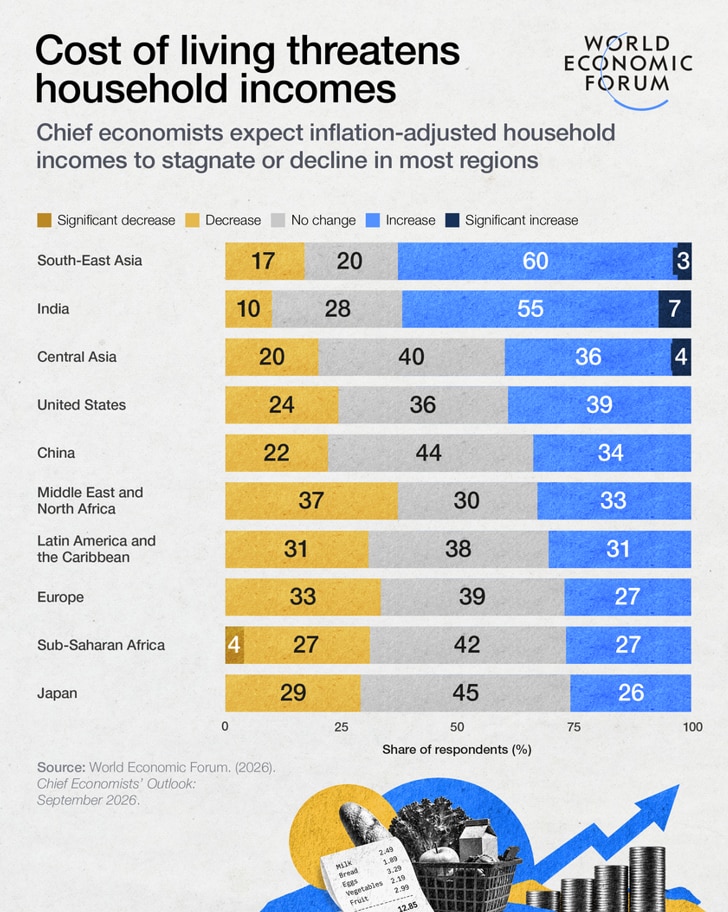
For many households, higher prices are arriving before earlier losses in purchasing power have been fully recovered. The Chief Economists’ Outlook finds that real incomes are expected to stagnate or fall across most regions over the coming year, with India and South-East Asia the main exceptions.
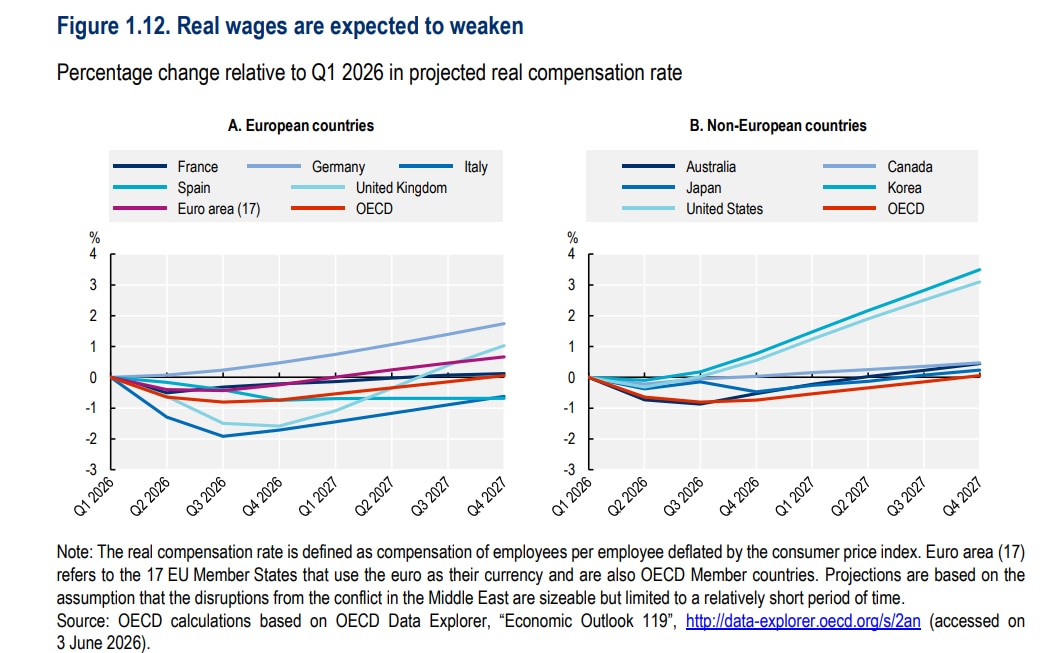
Across the OECD, real wages were still below their first-quarter 2021 level in 13 of the 37 countries analyzed in the first quarter of 2026. Although annual real-wage growth remained positive in almost all countries, the OECD average slowed to 2.2%, from 2.7% a year earlier.
The extent of the recovery differs sharply between countries. Real wages were 15.1% above their first-quarter 2021 level in Mexico and 5.7% higher in Korea. By contrast, they remained 6.1% lower in Italy and around 5% lower in Australia, among the steepest shortfalls across major OECD economies.
This uneven recovery helps explain why resilient headline economic data do not necessarily translate into a stronger sense of financial security. Even where inflation rates are falling, price levels remain higher - and households whose wages have not caught up continue to feel the squeeze.
Is growth losing momentum?
The global economy has weathered successive shocks better than many forecasts suggested, but global growth momentum has recently slowed. The annualized pace of growth fell from 3.6% in the second half of 2025 to 2.6% in the first half of this year. The OECD projects global growth of 2.9% in 2026 and 3.0% in 2027.
The combination of uneven growth and renewed inflation pressure is creating an increasingly difficult trade-off for central banks. In September, the European Central Bank, the US Federal Reserve and the Bank of Japan each raised policy rates by 25 basis points, taking the ECB’s deposit-facility rate to 2.50%, the Fed’s target range to 3.75%-4.00%, and the Bank of Japan’s policy rate to 1.25%, respectively.
Other central banks moved differently. Brazil cut its Selic rate by 25 basis points to 13.75%, while the Bank of England held its rate at 3.75%. This divergence is likely to continue: 70% of chief economists surveyed expect monetary policy to tighten in Japan over the coming year, compared with 53% in the euro area and 42% in the United States; meanwhile, 49% expect policy to loosen in China.
These different paths reflect the uneven nature of the outlook. A faster normalization of energy markets could ease inflation and support activity, but prolonged supply disruption, extreme weather and tighter financial conditions could produce the opposite combination: higher prices and uneven growth.
Why do global imbalances matter?
Current-account imbalances widened in 2025, with China and the United States the main drivers. China’s surplus increased by around $300 billion, the largest absolute widening in 25 years, to approximately 0.6% of global GDP, while the US deficit reached around 0.9%.
These imbalances are not simply a question of bilateral trade. Large surpluses can put downward pressure on real interest rates and encourage leverage, while large deficits can leave economies more exposed to reversals in capital flows and corrections in asset prices. The IMF argues that sustained rebalancing therefore requires changes to domestic saving and investment, with action by both surplus and deficit economies.
Trade measures can redirect bilateral flows, but they do little to address those underlying macroeconomic drivers. The 24 September summit between US President Donald Trump and Chinese President Xi Jinping extended the two countries’ trade truce by two months, giving negotiators more time but leaving central questions around tariffs, purchases, critical minerals and technology restrictions unresolved.
Other news in brief
IMF and World Bank revise debt-risk framework. The institutions have approved changes to their framework for assessing the debt sustainability of low-income countries, giving greater weight to domestic debt and longer-term risks including climate change. Around 14% of low-income countries are currently in debt distress and another 33% are at high risk.
AI borrowing reshapes bond markets. Gross debt issuance by hyperscalers is projected to reach a record $420 billion in 2027, 60% above estimated 2026 levels, according to Goldman Sachs. Spreads on bonds from AI-related issuers have widened to around 115 basis points, compared with 78 basis points for the broader investment-grade market.
World Bank private-capital mobilization reaches a record. The World Bank Group mobilized $112 billion in private capital in the 2026 financial year, up from $35 billion in 2022. The total included $50 billion for upper-middle-income economies and $37 billion for lower-middle-income economies, while mobilization for low-income countries remained at around $3 billion.
License and Republishing
World Economic Forum articles may be republished in accordance with the Creative Commons Attribution-NonCommercial-NoDerivatives 4.0 International Public License, and in accordance with our Terms of Use.
The views expressed in this article are those of the author alone and not the World Economic Forum.
Forum Stories newsletter
Bringing you weekly curated insights and analysis on the global issues that matter.
More on Economic GrowthSee all

John Letzing
October 13, 2026


