5 inspiring community-led solutions turning the tide on pollution
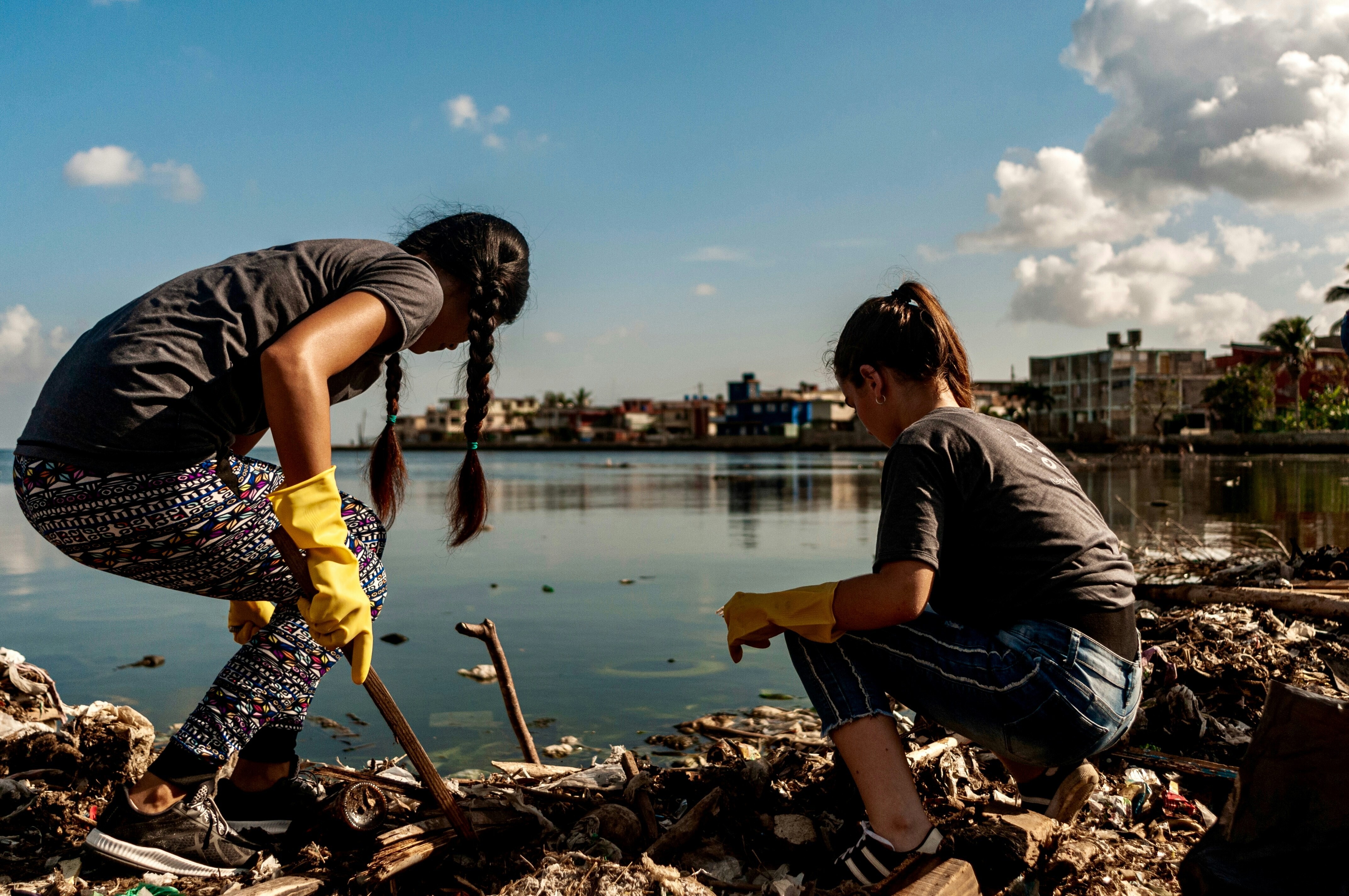
Young people closest to the harm caused by pollution are shaping solutions Image: Unsplash/Ricardo IV Tamayo
- Pollution harms health long before it becomes visible, and around 90% of the world's population lives with degraded land, unhealthy air, or water stress.
- Cheaper, more accessible monitoring technology is making pollution visible and its harms harder to ignore.
- Communities closest to the harm are shaping the solutions, yet pollution still attracts a small share of international finance.
Much of pollution goes unnoticed, invisible or so normalized in our daily lives that we barely register the haze over a morning commute, the runoff in a local river or the microplastics in our soil, rainwater and bodies.
That is starting to change, as people are increasingly aware that pollution is harming their own communities. The scale of the problem, though, is still vast. Around 90% of the world's population lives with degraded land, unhealthy air or water stress. What has significantly improved is our ability to measure it.
Low-cost sensors, satellites, artificial intelligence-powered image recognition systems and open data platforms have moved monitoring out of laboratories and into the hands of local communities.
This visibility is driving action, with young people often leading it, collecting data in their own neighbourhoods, calling for change and building solutions tailored to the local context. Across air, water and soil, communities are showing that pollution is measurable and solvable.
As the world observes International Youth Day, we highlight five community-led solutions from around the world. Each shows how local action can grow into global progress.
1. Leveraging data to manage water resources
We can’t act on what we can’t see, or at least there is less motivation to do so. That’s why making pollution visible through data monitoring is often the first step to tackling it.
The Gems of Water initiative, from youth-led non-government organization Coral Conservation and the European Commission's Joint Research Centre, uses a co-creative and inclusive approach with citizens and scientists to screen rivers for agrochemicals, industrial compounds and pharmaceuticals.
The programme generates data and trends that strengthen local capacity to monitor and manage water resources.
For example, it trained communities in Costa Rica’s banana-farming areas to look for the contaminants that routine monitoring often misses. Equipping residents with the knowledge, skills and resources to gather this evidence empowers them to participate in decision-making about their own environment, particularly when the data is credible.
Communities that calibrate tools, document methods and are transparent about their limits produce evidence that is hard to dismiss.
2. Maximizing local knowledge
The same pollution can manifest differently in every city, requiring solutions for the local context.
Greening urban spaces is widely used as a natural solution to cool cities, restore biodiversity, absorb heavy rainfall and clean the air. However, schools, hospitals and underserved communities often suffer the worst health effects from air pollution and high temperatures.
Involving local communities ensures a targeted approach that maximizes impact and ensures an equitable approach to shaping spaces.
In the Netherlands, the Tegelwippen or "tile whipping" competition involves residents replacing paving with soil and plants, with more than 11 million tiles replaced since 2020. This approach tackles several pollutants at once.
Paved surfaces send rainwater, as well as the oils, metals and tyre-wear microplastics it carries, straight into rivers, while bare soil filters it. The same greenery cools streets in heatwaves and softens the noise that bounces off concrete.
Tegelwippen shows how local knowledge ensured the right solution was implemented for the area. It can also be adopted by other communities facing the same challenges with paved-over streets and heavier rainfall.
3. Building models that can adapt to new needs
A local project can be replicated globally. The Breathe Cities initiative began in 2018 as a London pilot to clean up its air. It has since grown into a network of 16 cities across five continents, with more than 60 others engaged through peer learning and knowledge exchange.
Delivered by Bloomberg Philanthropies, Clean Air Fund and C40 Cities, this initiative aims to reduce air pollution by an average of 30% across participating cities by 2030.
Cities and their young people also don’t need to act alone. The Global Shapers Community is a network of 450 city-based hubs and over 11,000 youth leaders under 30. The hubs share learnings, collaborate and turn local data into action to tackle plastic and air pollution.
This is where local and global reinforce each other. With growing public awareness, a concrete understanding of local context and the energy to act, a solution that works in one community becomes a model that others can learn from and adapt.
4. Preventing health impacts to communities
Pollution often has its greatest impact on communities living closest to polluted waterways and waste hotspots, making locally-led solutions particularly important.
In Panama City, the Juan Díaz River faces significant plastic pollution. Community organization Marea Verde developed Wanda Díaz, a solar- and water-powered wheel that has captured more than 500 tonnes of waste before it could reach the sea.
In addition to cleanup, the community generates local river data using AI-powered cameras to identify and map plastic in real time, paired with recycling and education programmes that have reached thousands of residents across the watershed.
Communities burdened by city pollution are not resigned to it or willing to accept health impacts as a price of development. A 2026 survey of more than 11,000 residents across Accra, Delhi, Jakarta and Johannesburg found that air quality ranked as a top priority even when tackling it carried an economic cost.
5. Using local proof to gain global backing
What communities cannot do alone is pay for change at scale. Pollution attracts a small fraction of international finance. Only around 1% of international development funding goes to tackling outdoor air pollution and only 2% of international public climate finance.
Where public investment and regulation do arrive, local fixes become national norms. In Nepal, brick kilns were among the largest single sources of pollution in the Kathmandu Valley.
Rebuilding them to a zigzag firing design, which stacks bricks, so heat circulates more efficiently, cuts fuel use by around 20% and particulate emissions by up to 70%. What began as a technical fix in one valley is now mandatory across Nepal and is being adopted in Bangladesh, India and Pakistan.
The gains extend beyond the air: less black carbon settling on Himalayan glaciers means slower melting of the Indus, Ganges and Brahmaputra rivers, which supply water to more than 750 million people downstream.
That is the pattern worth funding. Communities identify solutions and prove what works in their own cities, giving governments and investors a tested model to build on.
The returns are not only environmental. Cleaner air and land are an economic strategy. In India alone, targeted clean air action could unlock more than $200 billion in economic opportunity and support over 100 million new or transitioned jobs, much of it in the communities that carry the heaviest burden.
Young people are often at the heart of this work and have the most at stake in the decisions made today. According to the Global Risks Report 2026, pollution ranks as the sixth most severe global risk among people under 30.
The next step is to match that momentum with the funding, technology and political will to take these solutions to scale. Let this International Youth Day be a reminder that local energy from the youth needs backing: the funding, technology and political will to turn it into global change.
Don't miss any update on this topic
Create a free account and access your personalized content collection with our latest publications and analyses.
License and Republishing
World Economic Forum articles may be republished in accordance with the Creative Commons Attribution-NonCommercial-NoDerivatives 4.0 International Public License, and in accordance with our Terms of Use.
The views expressed in this article are those of the author alone and not the World Economic Forum.
Stay up to date:
Air Pollution
Related topics:

Forum Stories newsletter
Bringing you weekly curated insights and analysis on the global issues that matter.
More on Climate Action and Waste Reduction See all

Daniel Mahadzir
September 24, 2026