How avoided emissions can help unlock investment in low-carbon innovation
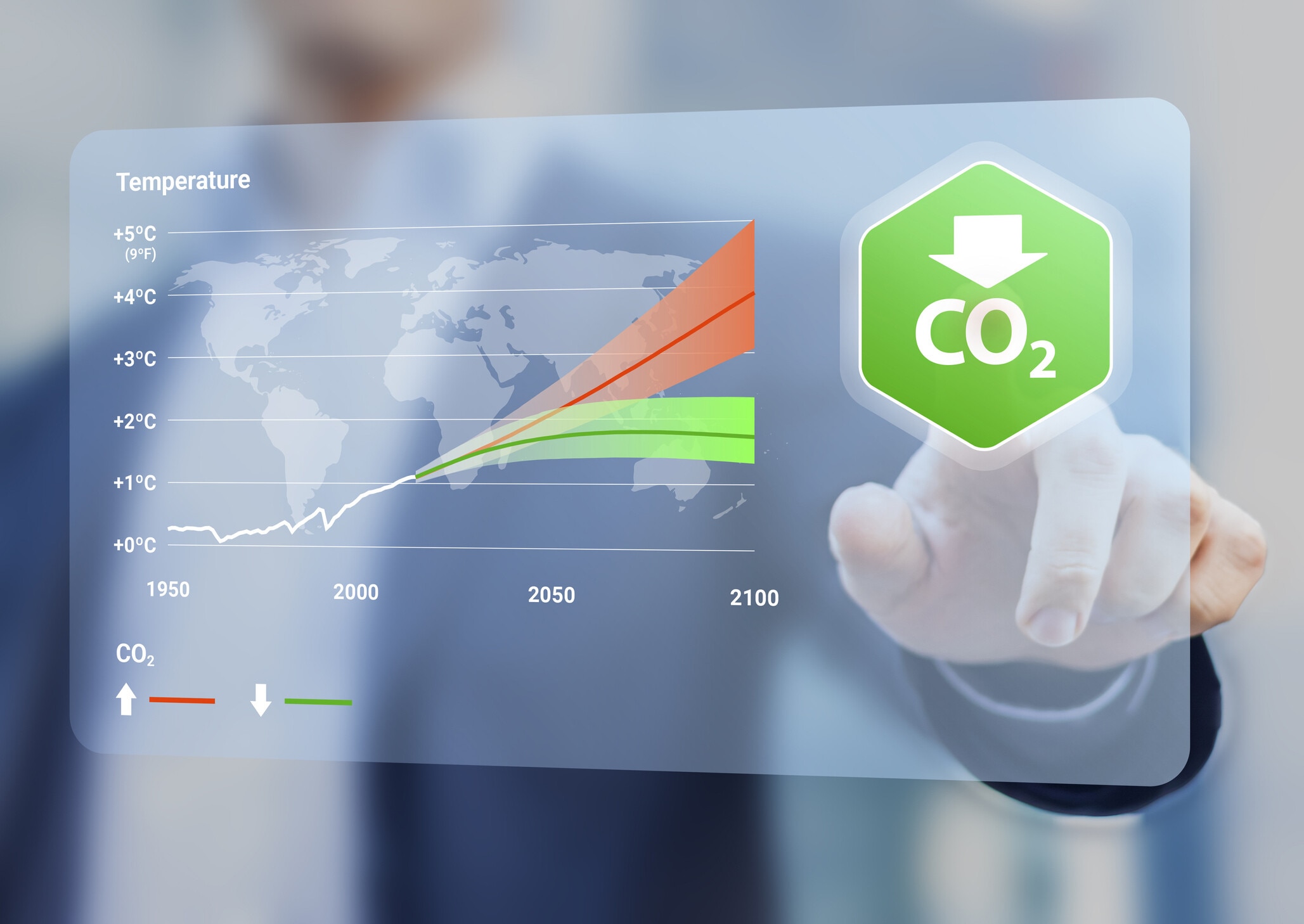
Avoided emissions measure how products and services help customers reduce their greenhouse gas emissions. Image: Getty Images/iStockphoto
- Global emissions reporting is under pressure to better integrate metrics that guide investment and policy decisions towards the green transition.
- However, questions remain around whether current carbon accounting sufficiently captures corporations' efforts to reduce emissions.
- Recognizing avoided emissions could help channel investment towards technologies that accelerate the low-carbon transition.
After more than two decades in place, the global emissions reporting architecture is at an inflection point, under increasing pressure from regulators, investors and decision-makers to better integrate metrics that not only measure emissions accurately, but also better guide real-world investment and policy decisions towards the green transition.
At the core of this system is the GHG Protocol, which established the carbon accounting standards around direct (Scope 1), energy-related (Scope 2) and value chain emissions (Scope 3) most widely used by businesses around the world.
Although it has been instrumental in increasing corporate climate transparency, questions remain around whether the current measurement system sufficiently captures the efforts of corporations to reduce their carbon footprint.
Gaps in current carbon accounting standards
One potential gap in recognition is for manufacturers producing quality solutions with significant potential to reduce the emissions of their end users.
Toray, a Japanese fibre manufacturer, is a key supplier of carbon fibre reinforced plastics (CFRP) for aircraft manufacturer Boeing. An aircraft incorporating their materials can weigh up to 20% less than a conventional model, which translates to a roughly 7% reduction in emissions over the aircraft’s lifecycle. However, no institutional framework or standard recognizes that 7% as a legitimate contribution to the reduction of the company’s overall carbon footprint.
Leading air conditioner manufacturer Daikin emitted 313.09 million tons of carbon dioxide (CO₂) in 2024. Of that, 262.6 million tons, or 83.9%, were attributed to the use of its products in the market. At the same time, the sale of more energy-efficient products contributed to the reduction of 48.2 million tons of CO₂ for that same product use phase.
Meanwhile, electric appliance manufacturer Panasonic has been measuring and disclosing its “Contribution Impact” to demonstrate how its products are helping to reduce their users’ GHG emissions and has called for an internationally recognized standard to measure and report such impact.
Introducing avoided emissions
What Panasonic calls its “Contribution Impact” is widely known as “avoided emissions”. The World Business Council for Sustainable Development (WBCSD) defines avoided emissions as “positive impact created when comparing the GHG impact of a low-carbon solution to an alternative scenario without that solution in place.”
For certain industries, the concept is nothing new. Back in 2013, the chemical industry published a methodology document to assess and report avoided emissions. Building on the study, the Task Force on Climate-related Financial Disclosures (TCFD) incorporated “avoided GHG emissions through the entire product life cycle” in its recommended disclosure for metrics and targets in its final report published in 2017.
Since the concept’s inception, avoided emissions have attracted some criticism. Most notably, corporate disclosures which deducted avoided emissions from the reporting entities’ regular GHG inventory were confusing to readers.
To address this, WBCSD has published a series of guidelines between 2023 and 2026 on how to appropriately use the concept of avoided emissions, including the recommendation to calculate and report avoided emissions separately and distinctly from GHG inventories.
Soon after the launch of WBCSD’s first report in March 2023, the G7 energy and environment ministers convening in Sapporo, Japan, acknowledged the importance of the concept in their ministerial communique.
In parallel, GX League, a forum for Japanese corporations to achieve carbon neutrality through joint initiatives, published several guidance documents on avoided emissions which have since been further refined through intensive discussions among like-minded business practitioners.
They emphasized the importance of avoided emissions serving to enhance climate-related opportunities of reporting entities, as opposed to focusing solely on climate-related risks. The work of the GX League is expected to be taken up by its successor, the GX Future Consortium.
Early in 2026, the International Electrotechnical Commission (IEC), an international standard setter for electric and electronic technologies, published an International Standard on the quantification and communication of avoided emissions from relevant products and systems.
Later in the year, the GHG Protocol initiated a public consultation on a white paper pertaining to “actions and market instruments", which includes a section on avoided emissions from the use of sold products.
The fact that the governing body on GHG inventory called for comments on the subject is indicative of the growing level of public attention.
A pivotal role for finance on avoided emissions
The development of evaluation methodologies on avoided emissions has so far largely been driven by high-emitting industries. What is needed now is buy-in from investors and financial actors.
Incorporating avoided emissions in investment and lending decision-making would encourage corporations equipped with relevant technologies to do more. Here, some investors are already showing the way forward.
As a leading financial services group, Nomura, which has led the discussion on avoided emissions at one of the GX League’s working groups, recently published a report on whether avoided emissions can contribute to enhancing enterprise value from an investor’s perspective.
In the climate-related analysis of its equity portfolio, Nomura Asset Management, a company within the group, found limitations in considering only corporate GHG emissions. The firm was concerned that an investee’s emissions were shown as increasing, despite contributions to reduce society-wide emissions through increased sales of low-emitting products. The introduction of avoided emissions as a metric to evaluate the growth potential thus made sense for the asset manager.
London-based Schroders is another investor that has incorporated avoided emissions in its investment analysis. Schroders sees it as a means to evaluate its investees’ potential ability to attract demand from the market.
In response to this growing investor interest, Toray has an ambition to increase its avoided emissions 25-fold by 2030, relative to 2013 results. Meanwhile, Panasonic is aiming for 200 million tons or more of avoided emissions annually by 2050.
Advancing recognition and appropriate disclosure
We are early in the process. To further scale avoided emissions as a widely accepted metric, we still need to solve a series of challenges, as set out in WBCSD guidance and the IEC standard.
We can start by setting more refined definitions for technical elements such as baselines, reference scenarios and attributions, while encouraging the disclosure of calculation conditions.
When used appropriately, avoided emissions can enable businesses to realize their carbon-reduction aspirations by producing products and services that effectively reduce broader emissions for users.
Don't miss any update on this topic
Create a free account and access your personalized content collection with our latest publications and analyses.
License and Republishing
World Economic Forum articles may be republished in accordance with the Creative Commons Attribution-NonCommercial-NoDerivatives 4.0 International Public License, and in accordance with our Terms of Use.
The views expressed in this article are those of the author alone and not the World Economic Forum.
Stay up to date:
Sustainability Reporting


Forum Stories newsletter
Bringing you weekly curated insights and analysis on the global issues that matter.
More on Climate Action and Waste Reduction See all

Pim Valdre and Joy Shumake-Guillemot
September 17, 2026